Confirming a figure this site had already cited before this page existed
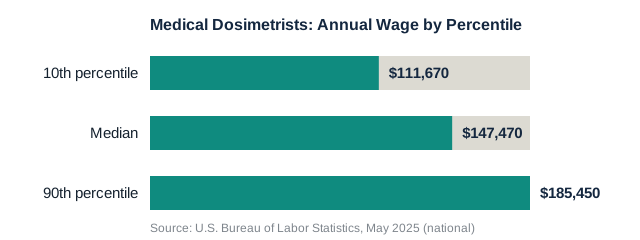
A medical dosimetrist earned a median of $147,470 a year in May 2025, or $70.90 an hour, per the Bureau of Labor Statistics, which profiles this occupation on its own page under SOC code 29-2036. The bottom 10% of earners made less than $111,670 a year, while the top 10% made more than $185,450, a spread of roughly $73,780. This is a small occupation in headcount terms: BLS counted just 3,500 medical dosimetrists nationwide in 2025, a fraction of the 343,000 clinical laboratory technologists and technicians this site covers elsewhere.
That $147,470 figure was not new information when this page went up. BLS's own page for radiation therapists lists medical dosimetrists in a Similar Occupations comparison table with the same median, calling it the highest figure of any occupation in that table, about $42,160 above the radiation therapist number. This page independently confirms that figure directly from the dosimetrist occupation's own dedicated BLS page, rather than relying on a comparison-table entry on someone else's page.
Industry pay comes in a narrower band than most occupations on this site
BLS breaks out May 2025 wages across three industry categories for medical dosimetrists. Outpatient care centers paid the highest median, at $174,400. Offices of physicians paid $148,190, and hospitals, state, local, and private combined, paid $147,010, the least of the three. The gap between the highest- and lowest-paying settings is $27,390, a narrower spread than this site found for radiation therapists, where the same three settings differ by $23,420 on a much lower base, or for optometrists, where the four tracked industries span nearly $78,000.
BLS's Work Environment section for this occupation states that most medical dosimetrists work in healthcare settings such as hospitals and physicians' offices, without giving a percentage breakdown of how the 3,500-person workforce splits across the three tracked industries. That means this page can report what each setting pays but not how many dosimetrists actually work in the highest-paying outpatient-care setting versus the other two.
A four-year degree and a specific certifying body, in an occupation BLS also flags as tightly clustered
Per BLS, medical dosimetrists typically need a bachelor's degree in medical dosimetry or a related field such as biology or physical science, then must complete an accredited medical dosimetry program that includes coursework in physics, anatomy, and radiology alongside supervised clinical experience. Applicants without a dosimetry-specific undergraduate degree can instead complete a graduate certificate or master's program in the field. BLS notes that admission is often competitive and that some programs require applicants to already be a registered radiation therapist or to hold a bachelor's degree with specific coursework in biology, medical terminology, and calculus.
BLS states that employers usually prefer to hire dosimetrists holding a credential it calls the CMD but does not name the issuing body on the page. Independently of BLS, that credential, the Certified Medical Dosimetrist (CMD), is issued by the Medical Dosimetrist Certification Board (MDCB), which requires a bachelor's degree, graduation from an accredited program, and a passing exam score, plus ongoing continuing-education hours to maintain the credential. The related professional association, the American Association of Medical Dosimetrists (AAMD), separately publishes its own definition of a "qualified medical dosimetrist," a title distinct from, but built on top of, the BLS-tracked occupation and the MDCB's CMD exam.
A small but faster-growing field, where 200 openings a year covers almost the entire projected job gain
BLS projects 5% employment growth for medical dosimetrists from 2025 to 2035, classified as faster than the average for all occupations, adding an estimated 200 jobs to the 3,500-person 2025 workforce. About 200 openings a year, on average, are projected over the decade, a figure BLS says mostly reflects the need to replace workers who transfer to other occupations or leave the labor force, such as to retire, rather than newly created positions. Because the occupation is small, that annual openings figure lands close to the total 10-year employment change BLS projects, a pattern this site has not seen on its larger occupation pages, where annual openings typically run well above the total employment change.
Against the other radiation-oncology roles this site tracks, dosimetrists' 5% growth rate outpaces the 4% BLS projects for nuclear medicine technologists and the 3% it projects for radiation therapists, even though dosimetrists already carry the highest median pay of the three. BLS does not explain on any of the three pages why the highest-paying role also has the fastest projected growth; an aging population needing more cancer treatment is the more general demographic driver BLS cites for radiation-oncology occupations broadly, not a claim specific to this one page.