What optometrists earn, and the doctoral degree BLS says it takes to get there
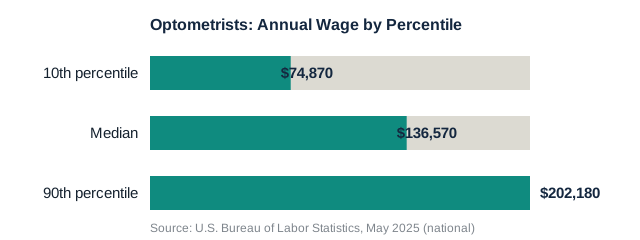
The Bureau of Labor Statistics tracks this occupation under SOC code 29-1041, on a page dedicated to optometrists alone. For May 2025, BLS reported a median annual wage of $136,570, or $65.66 an hour. The bottom 10% of earners made less than $74,870 a year, while the top 10% made more than $202,180, a spread of roughly $127,310. BLS does not attribute that spread to any single factor on this page, though the industry breakdown below and the setting where most optometrists actually practice account for some of it.
BLS lists a doctoral or professional degree as the typical entry-level education for this occupation, specifically a Doctor of Optometry (O.D.) degree that takes four years of graduate-level study, with applicants typically holding a bachelor's degree before entering. That places optometrists in the same broad credential tier as pharmacists, whose PharmD is also a four-year professional doctorate; BLS reports a $137,480 median for pharmacists, just $910 above the optometrist figure, and veterinarians, whose DVM sits at $130,100, about $6,470 below optometrists despite a similarly structured four-year doctoral path.
These figures come from BLS's Occupational Employment and Wage Statistics survey, which draws wage data from employer payroll and self-employment records rather than worker self-reports or job-board postings, the kind of data behind several of the aggregator sites (Indeed, ZipRecruiter, Glassdoor) that also surface for this search term. The same OEWS survey counted about 45,100 optometrist jobs in 2025.
Where the pay is highest, and where most optometrists actually work
BLS breaks out May 2025 wages by industry for optometrists, and the pattern runs opposite to what a job seeker might expect. Outpatient care centers paid the highest median, $207,030, but BLS's own employment data shows only 4% of optometrists actually work there. Retail trade, the setting most people probably picture first, given how many optometry practices sit inside chain eyewear stores, paid $159,250 and employs 13% of the field. Offices of physicians paid $145,630 (14% of the workforce). Offices of optometrists, the single largest employer at 61% of all optometrist jobs, paid the least of the four tracked categories: $129,250, some $77,780 below the top-paying setting.
That is close to the opposite of what this site found for veterinary pay, where veterinary services, the industry employing 83% of the field, ranked second of four tracked categories and sat just $1,770 below the top. For optometrists, the single most common workplace is also the lowest-paying industry BLS tracks, a genuinely different shape than most of the doctoral-degree occupations this site has covered so far. BLS does not explain the gap beyond publishing the figures; independent factors like private-practice ownership structure, insurance reimbursement rates, and local market saturation of optometry offices likely play a role, but BLS's OEWS data does not isolate any of them.
Becoming an optometrist, and a three-way mix-up BLS itself flags
Per BLS, prospective optometrists need a Doctor of Optometry (O.D.) degree from an accredited program, a four-year course of classroom instruction and supervised clinical training that typically follows a bachelor's degree, though applicants need only three years of completed undergraduate coursework to apply. BLS describes an entrance exam covering four subject areas: natural sciences, reading comprehension, physics, and quantitative reasoning, without naming it on the page. Independently of BLS, that description matches the Optometry Admission Test (OAT), sponsored by the Association of Schools and Colleges of Optometry (ASCO) and required by every U.S. optometry program, whose four sections (Survey of the Natural Sciences, Reading Comprehension, Physics, and Quantitative Reasoning) line up with BLS's own description.
All states require optometrists to be licensed, which BLS describes as passing "all sections of a qualifying exam" plus, in some states, an additional exam on clinical skills or state optometry law. Independently of BLS, that qualifying exam is administered by the National Board of Examiners in Optometry (NBEO), split into an Applied Basic Science part, a Patient Assessment and Management part, and a further practical exam that many states also require; per the Association of Regulatory Boards of Optometry (ARBO), passing NBEO's entry-level licensure exams is a requirement in every U.S. jurisdiction, a multi-part structure with more required components than the single national exam (NAVLE) this site found for veterinarians.
BLS also flags a mix-up worth naming directly, since it shows up in this site's own "Similar Occupations" research: opticians, listed separately at a $47,260 median (high school diploma typical entry, per BLS's table on this same page), fit and sell eyeglasses and, in some states, fill contact lens prescriptions, but they do not examine eyes or write those prescriptions themselves. That job belongs to optometrists or to ophthalmologists, physicians who additionally perform eye surgery and are covered under the much broader "Physicians and Surgeons" BLS category, listed on the same table at a $275,930 median, a figure that blends dozens of medical and surgical specialties rather than describing ophthalmology specifically.
Job outlook, next to the other doctoral-degree fields this site tracks
BLS projects 10% employment growth for optometrists from 2025 to 2035, classified as much faster than the roughly 3% average across all occupations, adding an estimated 4,300 jobs to the 45,100 already employed and about 2,000 openings a year on average. BLS attributes most of those annual openings to workers transferring to other occupations or leaving the labor force, such as to retire, rather than to newly created positions alone.
Among the doctoral-degree occupations this site has covered, only physical therapists, at 11% projected growth, outpace optometrists. Optometrists' 10% comfortably beats the veterinarian figure at 9%, psychologists at 6%, and both pharmacist growth and lawyers, each projected at a more modest 4-5%. BLS does not explain why optometry's outlook runs ahead of most other doctoral fields it tracks; an aging U.S. population that needs more vision correction and eye-disease management is the more general demographic factor BLS cites for eye-care occupations broadly, not a claim specific to this one page.