U.S. salary & occupation data · BLS sourcedSer. 2026
Salary GuideSOC 29-1123
Physical Therapist Salary: BLS Wage Data by Percentile (2026)
BLS puts the median physical therapist salary at $101,020 a year. Full percentile breakdown, industry comparison, and what a DPT degree buys you.
Last updated 2026-08-03 · Wage data: May 2024 (BLS)
Key figures
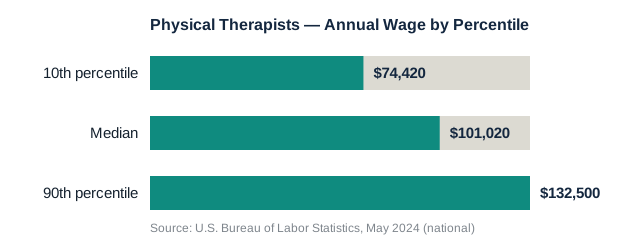
The median annual wage for physical therapists was $101,020 in May 2024, according to the Bureau of Labor Statistics. The bottom 10% earned less than $74,420 and the top 10% earned more than $132,500. Home healthcare services paid the highest industry median ($108,110), while private outpatient therapy offices paid the lowest of the tracked categories ($94,860).
Physical Therapists: Annual Wage by Percentile (May 2024, U.S. national)
Enter your own pay as a physical therapists, either annual or hourly, and this tool locates it against the BLS wage percentiles above.
If you moved industries
These are published industry medians for physical therapists, not a personalized prediction for your salary.
BLS publishes a median hourly wage of $48.57 for this occupation; that real figure is used as the hourly reference. Your own hourly-to-annual conversion assumes 2,080 hours/year (BLS full-time convention).
Offices of physical, occupational and speech therapists
$94,860
Jobs (2024)
267,200
Outlook (2024-34)
11%
Employment change
+29,300
Typical entry education
Doctoral or professional degree (DPT)
What a DPT degree translates to in pay
Physical therapy became a doctoral-entry profession in the United States over the 2000s and 2010s; nearly all practicing PTs today hold a Doctor of Physical Therapy (DPT) degree, typically a three-year program after a bachelor's degree, followed by a national licensing exam. BLS data from May 2024 puts the median annual salary at $101,020, or $48.57 an hour, for that credential.
The percentile range is moderate compared to some other occupations on this site: the bottom 10% of PTs earned less than $74,420, and the top 10% earned more than $132,500 in May 2024, roughly a $58,000 gap. That is consistent with a single-credential profession where pay differences come mainly from setting, geography, and years of experience rather than large differences in required qualifications. For another clinical field's BLS wage data by percentile, see this site's respiratory therapist salary guide.
Setting matters more than most people expect
BLS breaks out May 2024 wages by industry, and the pattern is somewhat counterintuitive: home healthcare services paid the highest median at $108,110, ahead of nursing and residential care facilities ($105,330) and hospitals ($105,140). Private outpatient physical therapy offices, the setting many people associate with PT work and where a large share of PTs are employed, paid the lowest of these four categories, at $94,860.
The gap likely reflects staffing economics: home health and skilled nursing settings often pay a premium to attract PTs willing to travel between patient locations or work in facility settings with higher patient acuity, while private outpatient practices compete more on schedule flexibility and caseload variety than on base pay. A similarly lopsided pattern turns up in this site's orthotist and prosthetist salary guide: the two industry categories with the smallest employer share there, federal government and hospitals, land at opposite ends of the pay scale rather than near the middle.
Job outlook
BLS projects 11% employment growth for physical therapists from 2024 to 2034, classified as much faster than average, adding about 29,300 jobs over the decade, one of the stronger growth projections among the healthcare occupations tracked on this site. An aging population with rising rates of chronic conditions that benefit from physical therapy (orthopedic injuries, stroke recovery, mobility-related conditions) is the primary driver BLS cites for continued demand. That 11% pace trails the 13% BLS projects through 2035 for forensic scientists, a separately tracked field where BLS typically requires only a bachelor's degree for entry.
Frequently asked questions
What is the median physical therapist salary?
BLS puts the 2024 figure at $101,020 a year for the occupation, or $48.57 an hour.
Do physical therapists need a doctoral degree?
Yes. Since the field transitioned to doctoral-level entry education, practicing PTs need the DPT credential plus a passing score on the National Physical Therapy Examination and state licensure.
What setting pays physical therapists the most?
$108,110 at home health agencies is the highest of the four employer categories BLS tracked for May 2024. A residential and skilled-care facility setting followed at $105,330, hospitals came in at $105,140, and standalone outpatient PT clinics trailed the group at $94,860.
Is physical therapy a growing field?
Yes, per BLS: 11% projected job growth for the occupation between 2024 and 2034, well above the roughly 3% average across all U.S. occupations, adding an estimated 29,300 positions over the decade.
How long does it take to become a physical therapist?
A typical four-year undergraduate degree with prerequisite coursework, followed by a CAPTE-accredited DPT program that BLS describes as running about three years, adds up to roughly seven years before a graduate is eligible to sit for the licensing exam, per this site's how to become a physical therapist guide. Some PTs add an optional one-year clinical residency on top of that.
Is PT harder than RN?
BLS doesn't rate occupations by difficulty, but the credentialing timelines differ substantially. Physical therapy runs roughly seven years total, combining a four-year undergraduate degree with a three-year graduate DPT program. Registered nursing moves faster: per this site's how long is nursing school guide, BLS lists both the bachelor's (BSN) and associate's (ADN/ASN) nursing paths at about four years to completion, several years shorter than the DPT track.
WageLark Editorial, “Physical Therapist Salary: BLS Wage Data by Percentile (2026),” WageLark, published August 3, 2026, https://wagelark.com/physical-therapist-salary/.
This page reports government wage statistics for informational purposes. It is not personalized career, financial, or legal advice, and does not endorse or recommend any specific employer, school, or training program.