Why the range is so wide for an entry-level-education job
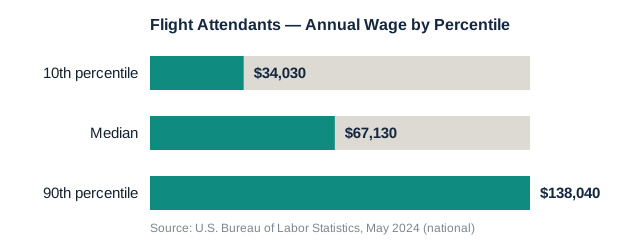
Flight attendant is one of the few well-paying occupations that typically requires only a high school diploma or equivalent to enter, per BLS. That makes the size of its pay range notable: the bottom 10% of flight attendants earned less than $35,110 in May 2025, while the top 10% earned more than $136,430, over a $100,000 spread within a single occupation that has a low formal education barrier to entry.
The explanation is seniority. Nearly all major U.S. airlines pay flight attendants under union contracts with seniority-based pay scales, where hourly rates increase substantially with years of service, and senior flight attendants get priority for the most desirable (and often highest-paying, due to international or long-haul premiums) routes and aircraft. A first-year flight attendant at a regional carrier and a 20-year flight attendant at a major international carrier are, in effect, in very different pay tiers despite sharing a job title.
BLS itself only publishes the 10th and 90th percentile split for this occupation, not a 25th or 75th percentile figure. U.S. News's flight attendant salary page, drawing on the prior year's BLS survey (its reported 2024 median of $67,130 matched that year's BLS figure exactly, before BLS's May 2025 update brought the median down to $63,580), put the 25th percentile at $52,280 and the 75th at $98,160. Those aren't re-verified against the newer BLS release, so treat them as a rough middle-half check on the extremes rather than a current figure: most flight attendants land well inside the full 10th-to-90th spread, and the largest jumps in pay tend to arrive later in a career, once seniority pushes someone past the middle of the range.
How airline type changes the number
BLS breaks out May 2025 wages by two industry categories: nonscheduled air transportation (largely charter and private-jet operations) paid a higher median at $70,700, compared with $63,570 at scheduled air transportation, the major and regional passenger airlines most flight attendants work for. That gap partly reflects the different pay structures and passenger mix of charter versus scheduled commercial flying.
It is also worth noting what published median pay figures do not fully capture for this occupation: flight attendants are traditionally paid only for scheduled flight time (wheels-up to wheels-down), not for time spent on the ground during boarding, delays, or layovers, though airline contract terms on this have shifted somewhat in recent years following industry-wide labor negotiations. BLS wage data reflects reported total compensation, but the hourly structure underlying it differs meaningfully from a typical hourly job.
Job outlook
BLS projects 9% employment growth for flight attendants from 2025 to 2035, classified as much faster than average, taking the occupation from 133,700 jobs to roughly 145,500, a net gain of about 11,800 positions. On top of that net growth, BLS separately estimates about 18,500 openings a year on average over the decade, since most yearly openings come from replacing workers who transfer out or retire rather than from new positions alone. Growth in air travel demand, plus regulatory minimum staffing requirements tied to aircraft passenger capacity, are the main drivers BLS cites. Airlines cannot simply run more flights without proportionally more crew, which links growth directly to industry capacity expansion in a way that is less true for some other service occupations.