How much pilots make per flight and per hour
An airline pilot's contract pay is an hourly rate for flight time, usually counted in block hours: the clock starts when the aircraft pushes back from the gate and stops when it parks at the other end. There is no set fee for flying a trip, so the pay for one flight depends on its block time, and a short hop pays less than a transcontinental leg for the same pilot.
BLS lists pilot pay only as an annual figure, so an hourly number has to be worked out, and the result is a yearly average per hour flown. BLS says airline pilots fly an average of 75 hours a month, roughly 900 a year, and spend another 150 hours a month on other duties. Spread the $232,140 median over 900 flight hours and you get about $258 per hour flown. Counted against all 225 working hours a month, the same salary is closer to $86 an hour. For passenger airlines, FAA rules in 14 CFR 117.23 also bar scheduling a pilot past 1,000 flight hours in any 365 consecutive days, so no passenger-airline pilot can log more than that.
Contract rates are a separate number, set by the airline, the aircraft, the seat, and seniority. AeroTime's July 2023 write-up of United's agreement in principle with its pilots, which still needed union approval at the time, listed $199.74 per block hour for a captain on the CRJ900, the smallest aircraft on that pay scale, and more than $386 for a captain on the Boeing 787.
Pilot pay splits into two BLS categories, and the gap is large
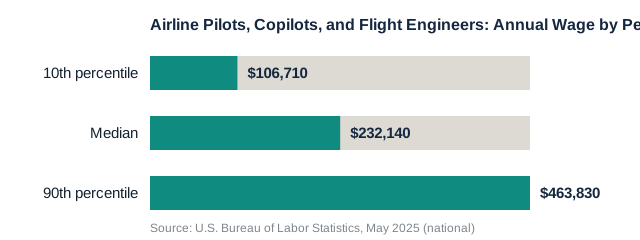
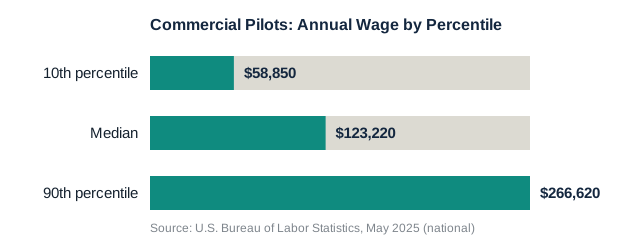
The Bureau of Labor Statistics does not track a single occupation called "pilot." Its Occupational Employment and Wage Statistics program splits flying jobs into two categories on the same Airline and Commercial Pilots page: airline pilots, copilots, and flight engineers, who fly scheduled passenger and cargo routes for major and regional airlines, and commercial pilots, who fly charter flights, aerial application, instructional flights, and other work outside scheduled airline service. The May 2025 median for the airline category was $232,140 a year; for the commercial category it was $123,220, a gap of just over $108,000 between two jobs that share a search term but not a pay scale.
The size of that gap traces mostly to what each job actually is. Airline pilots typically need a bachelor's degree plus experience as a commercial or military pilot before an airline will hire them, and once hired, most fly under union contracts with structured, seniority-based pay progression. Commercial pilots typically need flight training and FAA certification instead of a four-year degree, and the work covers a much wider range of employers, from charter operators to flight schools to agricultural spraying. A search for "how much do pilots make" without specifying which kind is, in effect, a question about two different labor markets that happen to share a job title.
Employment size differs too. BLS counted about 104,600 airline pilots, copilots, and flight engineers and about 50,400 commercial pilots in 2025, so the higher-paying airline category is also the larger of the two by headcount.
The percentile spread inside each category
Airline pilot pay is not evenly distributed even within the category. The lowest-earning 10% made less than $106,710 in May 2025, while the highest-earning 10% made more than $463,830, a spread of well over $350,000. BLS attributes most of that spread to seniority: airline pilots usually start their careers as first officers and receive wage increases as they accumulate experience and seniority, with the most senior captains at large carriers landing at the top of the range. Pilots also receive a per-diem expense allowance for every hour away from home and can earn extra pay for international flights, on top of the base wage figures reported here.
Commercial pilots show a narrower but still wide range: under $58,850 at the 10th percentile to over $266,620 at the 90th. That spread reflects the variety within the category more than seniority alone. A newly certified flight instructor building hours toward an airline job and a charter pilot flying jets for a corporate operator both fall under "commercial pilots" in BLS's data, despite very different pay and experience levels.
Which employers pay the most, by BLS's industry data
For airline pilots, BLS's industry breakdown holds a surprise: the highest median pay was not at passenger airlines. Couriers and express delivery services, the cargo carriers that fly for companies like UPS and FedEx, paid a median of $334,930 in May 2025, well above the $293,240 median at scheduled air transportation, the category covering the passenger airlines most people picture when they think "airline pilot." Support activities for transportation paid $202,680, and federal government employers (excluding the postal service) paid $141,140, the lowest of the four industries BLS breaks out for this occupation.
Commercial pilots show a similar shape at a lower altitude. Nonscheduled air transportation, the charter-flight industry, paid the highest median at $133,150, followed by professional, scientific, and technical services at $129,610 and support activities for air transportation at $123,090. Two smaller industries round out the list: other ambulatory healthcare services, which includes air ambulance operators, paid $100,330, and private technical and trade schools, where certified flight instructors are classified, paid $93,820, the lowest median BLS reports for either pilot category.
Job outlook and how the pay ladder actually works
BLS projects 8% employment growth for airline pilots, copilots, and flight engineers from 2025 to 2035, adding about 8,700 jobs to a base of 104,600. Commercial pilots are projected to grow 5% over the same decade, adding about 2,600 jobs. Both rates beat the 3% average projected across all U.S. occupations, and BLS classifies the combined airline-and-commercial-pilot outlook as much faster than average, citing rising demand for air travel and continued e-commerce-driven freight growth as the main drivers.
The path from a commercial pilot's median pay to an airline pilot's median mostly involves building flight hours and then getting hired by an airline, not a raise inside the same job. Airline pilots typically enter the field with a bachelor's degree and prior experience as a commercial or military pilot, so most of the highest earners on this page's chart started out flying lower-paying jobs first. Once hired, BLS notes pay climbs with seniority, which is a large part of why the 90th percentile for airline pilots, more than $463,830, sits over four times higher than the category's 10th percentile. Related reading on this site: flight attendant pay, another airline-crew role with a similarly wide, seniority-driven range, and air traffic controller salary, a non-flying aviation career where BLS puts the May 2025 median at $148,080, between the two pilot figures on this page.