What the median figure actually shows
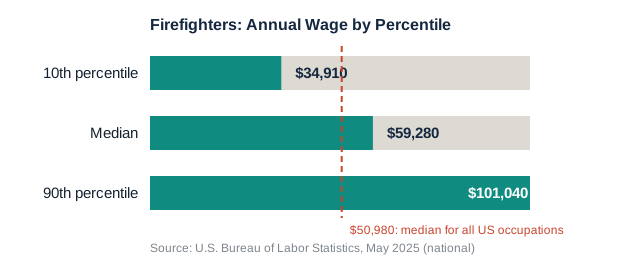
The Bureau of Labor Statistics files firefighters under SOC code 33-2011. Its May 2025 median annual wage for the occupation was $59,280, or $28.50 an hour.
The same survey put the median across all US occupations at $50,980. Read side by side, the firefighter midpoint sits about 16% above the typical worker, so the headline number does not support the premise that the job is badly paid in the middle of its range. BLS also groups firefighters with a wider set of firefighting and prevention workers, whose median was $59,630, close enough to the firefighter figure that the group total does not change the picture.
What a midpoint hides is the shape of the distribution, and who gets counted in it. The bottom of the range falls a long way below the national middle, and a large part of the occupation never appears in the wage table at all.
The bottom tenth, and the firefighters BLS leaves out
BLS reports the ends of the distribution along with the midpoint. The lowest-paid 10% of firefighters earned less than $34,910 in May 2025, roughly 32% below the median for all occupations, while the highest-paid 10% earned more than $101,040.
The same page draws a boundary that matters more than any single percentile. Its employment and wage figures exclude volunteer firefighters, who carry out the same duties as paid ones. BLS states that volunteers account for the largest share of firefighters nationwide, and that the share is biggest in communities of fewer than 25,000 people. In those places the person who answers a structure fire may be unpaid, while the $59,280 median describes only the paid part of the occupation.
Who employs that paid part is uneven as well. Local government accounted for 87% of the 355,300 firefighter jobs BLS counted in 2025, state government for 4%, and the federal government for 2%. Median pay ran in the opposite order: state government firefighters earned $64,980, federal ones $63,270, and local government ones $59,850, about 8% under the state figure. The employer of nearly nine in ten firefighters pays the least of the three.
The 7(k) work period, and why an annual figure mixes two kinds of hours
BLS notes that firefighters typically work long periods, that overtime is common, and that a 24-hour shift is often followed by 48 or 72 hours off duty. How that extra time is paid follows a federal rule that most hourly workers never encounter.
Section 7(k) of the Fair Labor Standards Act lets public agencies pay fire protection and law enforcement employees overtime on a work period basis instead of the standard 40-hour week. The Department of Labor fact sheet on the provision sets the work period at anywhere from 7 to 28 consecutive days. For a period shorter than 28 days, the overtime threshold scales in the same proportion that 212 hours bears to 28 days. Across a 14-day period, fire protection personnel are due overtime after 106 hours.
The rotation and the threshold interact. A 24-hours-on, 48-hours-off schedule works out to about 112 hours across a 14-day period, which clears the 106-hour line. A 24-on, 72-off rotation comes to about 84 hours in the same window, which does not. Whether a given crew generates overtime pay depends on the rotation rather than on the annual salary attached to the job.
When overtime is owed, cash is not the only settlement the rules allow. Under conditions the fact sheet sets out, a state or local agency may provide compensatory time at no less than one and one-half hours for each overtime hour worked, and police and fire employees may accrue up to 480 hours of it. An agency has to grant a request to use that time on the date asked for unless doing so would unduly disrupt its operations, and on termination the employee is paid the higher of the final regular rate or the average regular rate over the previous three years for whatever is left unused.
One further provision narrows the rule at the small end. Section 13(b)(20) exempts a public agency that employs fewer than five people in fire protection activities during a workweek from the overtime requirement. Between that exemption, the work period, and compensatory time, an annual figure for a firefighter blends regular hours with overtime hours, and part of the extra time may be settled in leave instead of money.
Who sets firefighter pay, and the federal wildland exception
With 87% of paid firefighters on local government payrolls, pay is set jurisdiction by jurisdiction, not on one national scale. That structure explains why the BLS national median summarizes many local decisions, and why the same job title can carry very different wages in two neighboring departments.
In March 2025 the Department of the Interior announced a permanent pay increase for federal and tribal wildland firefighters, carried in the Full-Year Continuing Appropriations and Extensions Act, 2025 (H.R. 1968), which Congress passed on March 14 and the president signed into law.
According to the department announcement, the law establishes new special salary pay tables for federal wildland firefighters at every level, including temporary and seasonal employees, and makes permanent the Bureau of Indian Affairs funding that lets tribes offer pay supplements to tribal wildland firefighters. It also creates wildland fire Incident Response Premium Pay, which the announcement describes as available to all federal employees for extended deployments to qualifying incidents.
The announcement describes the permanent increase as replacing temporary pay supplements that firefighters had received over the preceding four years. Until 2025, part of that pay rested on supplements that had to be renewed. The Office of Personnel Management publishes separate 2026 locality pay tables for wildland firefighters under a GW pay series of its own.
Where the rest of the firefighter material lives
Within this site, the same occupation is broken out by percentile and by employer type on the firefighter salary page, which carries the wage table in full. BLS also classifies the typical entry-level education for this occupation as a postsecondary nondegree award.
For a neighboring occupation on a shorter entry path, the guide to becoming a paramedic covers the credential tiers and the paramedic-specific pay figure. For the wider national picture, the salary statistics overview compiles figures across roughly 830 tracked occupations and documents its own methodology. One more occupation in the same BLS data carries a fatal injury rate well above the national average, and the lineman risk breakdown sets out the yearly numbers.