Three certification tiers, each built on the one before it
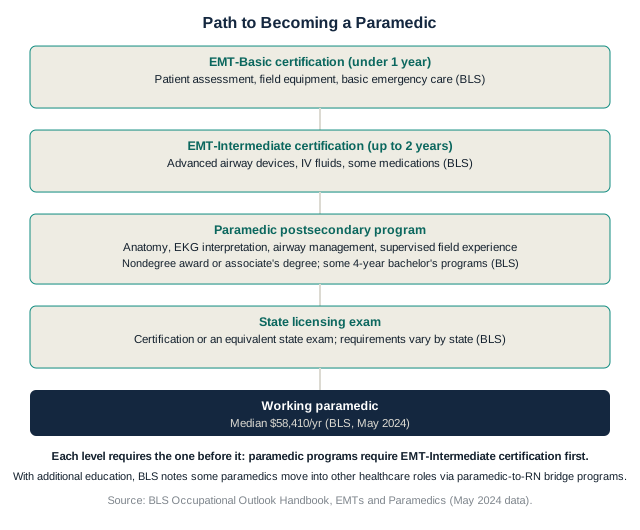
BLS covers EMTs and paramedics together in its Occupational Outlook Handbook, under the combined title "EMTs and Paramedics," but its How to Become One tab lays out a tiered structure rather than one flat entry path. EMT-Basic is the first level: programs typically take less than a year and cover assessing a patient's condition, handling emergencies, and using field equipment. EMT-Intermediate comes next, adding instruction in advanced skills such as complex airway devices, intravenous fluids, and some medications, in a program BLS says can run up to 2 years. A paramedic program is the third tier, and BLS is explicit that applicants need EMT-Intermediate certification just to enroll.
Paramedic programs themselves cover anatomy and physiology, EKG interpretation, and maintaining airflow, along with supervised field experience alongside working crews. Most run through community colleges and lead to a nondegree award or an associate's degree, though BLS notes some 4-year universities offer bachelor's-degree paramedic programs. Beyond the coursework, BLS states that paramedics typically need work experience as an EMT before entering a paramedic education program in the first place, and that working as a volunteer EMT or paramedic can help build that experience.
All states require EMTs and paramedics to be licensed, though BLS says the specific requirements vary by state: most require candidates to pass a certification exam, while others require passing an equivalent state exam instead. States can add their own conditions on top of that, such as a minimum age or a background check, and BLS points to CareerOneStop as a source for state-by-state licensing board requirements. Employers typically also require a driver's license, and BLS notes some prefer candidates to hold ambulance driver certification as well.
EMT and paramedic are tracked as separate BLS occupations, not just job titles
BLS narrates EMTs and paramedics on one Occupational Outlook Handbook page, but the two carry distinct 6-digit SOC codes underneath: EMTs sit under 29-2042 and paramedics under 29-2043, both inside the broader 29-2040 group. That distinction matters for the pay data, because BLS's Pay tab breaks out separate median wages and separate industry tables for each title rather than publishing one blended figure, the same kind of title-specific split this site has found on a handful of other combined-occupation BLS pages.
Per BLS, the qualities that matter for both EMTs and paramedics center on the pace and stakes of the work: communication skills, to listen to patients and dispatchers and give clear instructions; compassion, to support patients in life-threatening or highly stressful situations; interpersonal skills, to coordinate with a team and a wide range of people on scene; physical strength, for bending, lifting, and kneeling over a shift; and problem-solving skills, to evaluate symptoms and determine appropriate treatment on the spot.
BLS does not publish 10th and 90th percentile wages anywhere on this page, for EMTs, for paramedics, or for the combined group. That is a gap from most other occupations this site tracks, where BLS at least reports a percentile range even when it doesn't break wages out by job title.
Pay: a paramedic-specific median, and how it compares
BLS reports a median annual wage of $58,410 for paramedics in May 2024, above the $41,340 median for EMTs and the $46,350 median for the combined EMT-and-paramedic group on the same page, and also above the $49,500 median across all occupations that year. By industry, BLS's top-5 table for paramedics specifically shows local government (excluding education and hospitals) paying the highest median, $59,840, followed by offices of physicians at $59,370, private general medical and surgical hospitals at $58,780, ambulance services at $57,720, and local-government general medical and surgical hospitals at $52,990. Ambulance services, the setting most people probably picture first for this occupation, is not the top-paying industry BLS tracks for paramedics; local government and physician offices both pay more at the median.
BLS's industry table for EMTs, by contrast, shows outpatient care centers paying a median of $67,990, higher than any single industry BLS lists for paramedics. BLS does not explain that gap beyond publishing the figures, and it does not change the overall picture: EMTs' median annual wage across all industries is still well below paramedics', so one high-paying EMT industry segment does not mean EMTs typically out-earn paramedics.
Against other BLS occupations this site has covered that share the same "postsecondary nondegree award" entry-level classification, paramedic pay sits close to firefighters, whose $59,280 median is about $870 above the paramedic figure, and well above CNAs, whose $39,530 median is roughly 48% lower despite CNA training running a federal floor of just 75 hours rather than a multi-tier certification path. BLS does not weigh how much of these gaps traces to training length, scope of practice, or the settings each occupation typically works in.
Job outlook, and an advancement path BLS names specifically
BLS projects 5% employment growth for the combined EMT-and-paramedic occupation from 2024 to 2034, a rate it classifies as faster than the roughly 3% average across all occupations, with about 19,000 openings projected each year on average over the decade. As with most occupations BLS tracks, it attributes many of those annual openings to the need to replace workers who transfer to a different occupation or exit the labor force, such as to retire, rather than to newly created positions alone. That 5% figure and the 19,000-opening estimate cover EMTs and paramedics together; BLS does not publish a paramedic-specific growth rate or opening count on this page.
BLS names one specific advancement route out of the occupation: with additional education, paramedics can move into other healthcare roles, and it points to paramedic-to-RN programs as an accelerated pathway into becoming a registered nurse. This site's registered nurse pay guide reports a median annual wage of $93,600 for RNs in May 2024, $35,190 above the paramedic median, though BLS does not quantify how much of that gap a paramedic entering through a bridge program would actually see, since bridge-program graduates still need to pass the NCLEX-RN and complete whatever program length their specific bridge track requires.