What a plumbing apprenticeship actually involves
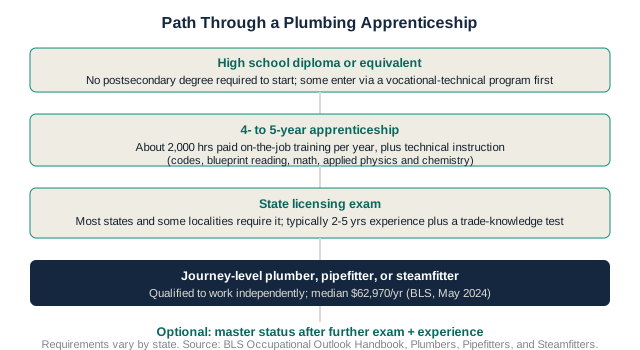
Per the Bureau of Labor Statistics, most plumbers, pipefitters, and steamfitters learn the trade through a 4- or 5-year apprenticeship, though some attend a vocational-technical school first. Apprentices typically receive about 2,000 hours of paid on-the-job training each year of the program, alongside technical instruction covering safety, local plumbing codes and regulations, and blueprint reading. BLS also notes that apprentices study mathematics, applied physics, and chemistry as part of that classroom component. Apprenticeship programs are sponsored by unions, trade associations, and businesses, not run as a single national program, which is why the specific application process and waitlist can vary a great deal by local union hall or contractor. Most apprentices enter a program directly, though BLS notes some start out as helpers or complete a pre-apprenticeship training program in plumbing or another trade first. For a related trade, see this site's guide to HVAC certification, covering EPA 608 requirements, training, and pay.
BLS tracks plumbers, pipefitters, and steamfitters together under one SOC code, 47-2152, and one shared Occupational Outlook Handbook page; it does not publish three separate profiles, so every pay and employment figure on this page covers the combined group, not plumbers alone. The three job titles share the same core skills, connecting pipes and testing pressure so a system is airtight and watertight, but differ in setting and material. Plumbers install and repair water, gas, and other piping systems in homes, businesses, and factories, including fixtures such as bathtubs and toilets and appliances such as water heaters. Pipefitters and steamfitters, sometimes called fitters, install and maintain pipes that carry chemicals, acids, and gases, mostly in manufacturing, commercial, and industrial settings, with steamfitters specializing in systems built for high-pressure liquids or gases.
What the apprenticeship pays, before and after journey level
BLS states directly that apprentices earn less than fully trained plumbers, pipefitters, and steamfitters, and that their pay rises as they take on more responsibility during the program, but the Occupational Outlook Handbook page does not publish a separate apprentice wage figure distinct from the fully qualified median. The number BLS does publish is the occupation-wide median for May 2025, $63,800 a year, or $30.67 an hour. The lowest 10% earned less than $44,150, and the highest 10% earned more than $108,420, a spread of more than $64,000 that reflects where a given worker falls across the apprentice-to-master progression, license status, industry, and region, not any single factor.
BLS places this occupation against two broader groupings on the same page. Construction trades workers as a whole had a median of $58,150, and the median across all occupations in the economy was $50,980. Plumbers, pipefitters, and steamfitters sit above both comparison figures.
BLS breaks out May 2025 wages by industry into four categories. Government employers, excluding state and local education and hospitals, paid the highest median at $71,660. Manufacturing followed at $65,770, ahead of heavy and civil engineering construction at $63,270. Plumbing, heating, and air-conditioning contractors, the industry that employs the largest share of workers in this occupation, paid the lowest of the four tracked categories, a median of $63,010.
How to go from apprentice to licensed plumber
BLS lists the typical entry-level education for this occupation as a high school diploma or equivalent, with no prior work experience required and on-the-job training delivered through an apprenticeship. After completing an apprenticeship and passing the required licensing exam, workers become journey-level plumbers, pipefitters, or steamfitters, qualified to perform tasks on their own, without direct supervision. Most states, and some localities, require plumbers to be licensed. Although the specifics vary by jurisdiction, BLS notes that states and localities often require 2 to 5 years of experience plus a passing score on an exam testing trade knowledge before allowing a plumber to work independently. BLS directs readers to their state's licensing board for the exact requirements and does not list every state's rules on its own page; this article follows the same approach, since a reader in one state cannot rely on another state's rules.
BLS breaks out where these workers are employed. Plumbing, heating, and air-conditioning contractors employ the largest share, 65%. Self-employed workers make up 8%, and BLS notes self-employed plumbers may be able to set their own schedules. Government employers, excluding state and local education and hospitals, account for 3%, heavy and civil engineering construction for another 3%, and manufacturing for another 3%. After reaching journey level, plumbers with several years of experience can pass a further exam to earn master status, and BLS notes some states require master plumber status specifically to obtain a plumbing contractor's license.
For readers comparing this apprenticeship route against other paths that skip a bachelor's degree, electricians follow a similarly structured 4- or 5-year apprenticeship starting from the same high school diploma entry bar, and BLS puts their median annual wage at $63,190, within about $600 of the plumbing figure above. Becoming a CNA sits at the other end of the training-length spectrum, a federal minimum of 75 hours rather than a multi-year apprenticeship, and BLS puts the median nursing assistant wage at $42,260, well below either trade. BLS data describes the aggregate labor market for each occupation; it is not a claim that any one of these paths is the better choice for a given person. Another apprenticeship trade, becoming a lineman, is covered separately with its apprenticeship, CDL, and pay details.
Job outlook, and what the growth number does and doesn't mean
BLS projects 7% employment growth for plumbers, pipefitters, and steamfitters from 2025 to 2035, which it classifies as much faster than the average for all occupations. That works out to an estimated 34,500 additional jobs and about 42,000 openings a year on average over the decade. As with most occupations BLS tracks, it attributes many of those annual openings to the need to replace workers who transfer to other occupations or leave the labor force entirely, such as to retire, rather than to newly created positions alone.
BLS attributes underlying demand to new construction as well as the ongoing need to maintain and repair plumbing systems in existing homes and other buildings. It also specifically calls out sprinklerfitters, one of the specialties within this combined occupation, as an area where employment is expected to increase because building codes in all states now require fire suppression systems.
That 7% figure outpaces the 6% BLS projects for construction trades workers as a whole, though it still trails the 9% BLS projects for electricians, a similarly structured apprenticeship trade covered elsewhere on this site; electricians and plumbers land within about $600 of each other on median pay. BLS does not explain, on this page, why one licensed apprenticeship trade is projected to grow faster than another; the projection describes national demand for the occupation as a whole. It is not a forecast for any specific employer, local union, apprenticeship program, or individual's job security or earnings trajectory, and someone weighing a specific program should look at that program's own placement data and local job market conditions alongside the national figures here.