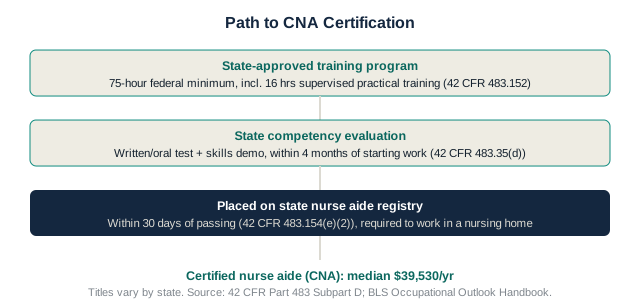
The federal floor: 75 hours, not a degree
Nurse aide training in the United States has a federal floor set by 42 CFR § 483.152: a state-approved program must run at least 75 clock hours, including a minimum of 16 hours of supervised practical training in which the trainee performs hands-on tasks on a person under the direct supervision of a registered nurse or a licensed practical nurse. That 75-hour figure is a national minimum, not a target. According to PHI, a national policy organization that tracks state nurse aide training rules, more than half the states set a higher bar than the federal floor, with some states requiring as much as 180 hours of instruction and clinical practice before a candidate is eligible to test.
The Bureau of Labor Statistics lists these programs as available through high schools, community colleges, vocational and technical schools, hospitals, and nursing homes themselves, meaning a candidate rarely has to enroll in a standalone college program the way a diagnostic medical sonographer or dental hygienist would. There is no associate or bachelor's degree requirement anywhere in the federal rule. That short, low-cost training window is the main structural difference between becoming a CNA and becoming most of the other entry-level healthcare roles covered on this site. A similarly bachelor's-or-master's-gated human-services role covered on this site, becoming a social worker, sits at the opposite end of that credential spectrum, per BLS.
The exam, the registry, and what counts as working legally
Finishing the training hours is not the last step. Federal rule 42 CFR § 483.35(d) caps how long someone can actually work as a nurse aide in a Medicare- or Medicaid-certified nursing home while still completing training and the competency evaluation: 4 months, after which the individual must have demonstrated competency to keep working in that role. The competency evaluation itself has two parts, a written or oral knowledge test and a hands-on skills demonstration. At the far opposite end of the training-length spectrum, this site's guide to the dental school timeline covers an 8-year path to practicing as a dentist, per BLS.
Once a candidate passes, federal rule 42 CFR § 483.154(e)(2) requires the state to add the record to its nurse aide registry, the one set up under § 483.156, within 30 days. Being listed on that state registry, not just holding a training certificate, is what BLS describes as the actual requirement to work in a nursing home. Titles vary by state even though the underlying federal training and testing rules are the same nationally: BLS notes that some states use the title "Certified Nursing Assistant," or CNA, while others use different state-specific titles for the same credential. Some states also offer a further credential, Certified Medication Assistant, which lets a CNA who completes additional training dispense medications, a task outside the base nurse aide scope.
What the job pays once certified
BLS reports a median annual wage of $42,260 for nursing assistants in May 2025 ($33,940 at the 10th percentile and $51,980 at the 90th). Pay varies meaningfully by setting: government employers outside state/local education and hospitals paid the highest median tracked, at $47,050, ahead of nursing care facilities, meaning skilled nursing facilities ($43,000), hospitals ($42,310), continuing care retirement communities and assisted living facilities ($39,490), and home healthcare services, the lowest of the industries BLS tracks for this role at $38,040.
BLS projects 3% employment growth for nursing assistants and orderlies combined from 2025 to 2035, about as fast as the average for all occupations, and about 203,300 openings each year on average across the decade. Most of those openings are expected to come from the need to replace workers who transfer to different occupations or exit the labor force, such as to retire, rather than from newly created positions. A different federally regulated short-training path, covered in this site's flight attendant certification guide, centers on FAA-mandated training rather than a state nurse aide registry.
CNA pay next to other quick-entry healthcare roles
Within the same BLS occupational family, nursing assistants and orderlies are two different jobs with two different entry bars and two different median wages. Orderlies, who transport patients and clean treatment areas rather than provide direct patient care, typically need only a high school diploma or equivalent plus a short period of on-the-job training, and do not need a state license or registry listing. BLS puts their median annual wage at $38,290, about $3,970 below the $42,260 nursing assistants earn for taking on the state-approved training, competency exam, and registry requirement that orderlies do not.
Against roles that require more formal postsecondary training, the CNA path still trails on pay but not by as much as the training-length gap might suggest. Medical assistants, who typically complete a postsecondary certificate or degree program, have a BLS median annual wage of $45,690, about $3,430 (roughly 8%) above nursing assistants. Phlebotomists, whose entry path runs through either a sub-year certificate program or, in some states, direct on-the-job training, have a BLS median of $43,660, about $1,400 (roughly 3%) above nursing assistants. BLS data describes the aggregate labor market for each occupation; it is not a claim that any one of these paths is the better choice for a given person.