U.S. salary & occupation data · BLS sourcedSer. 2026
How to BecomeSOC 31-9097
How to Become a Phlebotomist: Training, Certification, Pay
Becoming a phlebotomist usually takes under a year of training. Here is the real path (formal program vs. on-the-job route) plus BLS pay data.
Last updated 2026-08-03 · Wage data: May 2024 (BLS)
Key figures
Phlebotomists typically enter the field through a postsecondary certificate program lasting less than a year, or through employer-provided on-the-job training after a high school diploma. BLS reports a median annual salary of $43,660 in May 2024 and projects 6% employment growth through 2034, making it one of the fastest, lowest-cost entry points into clinical healthcare work.
Phlebotomists: Annual Wage by Percentile (May 2024, U.S. national)
Enter your own pay as a phlebotomists, either annual or hourly, and this tool locates it against the BLS wage percentiles above (this occupation only has a published median, not a fuller percentile breakdown, as noted below).
If you moved industries
These are published industry medians for phlebotomists, not a personalized prediction for your salary.
BLS publishes a median hourly wage of $20.99 for this occupation; that real figure is used as the hourly reference. Your own hourly-to-annual conversion assumes 2,080 hours/year (BLS full-time convention).
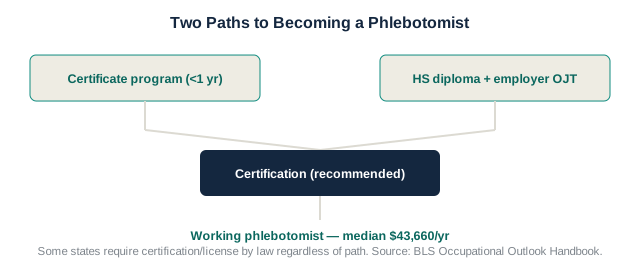
Unlike most healthcare roles on this site, phlebotomy does not have a single standard education requirement. The Bureau of Labor Statistics describes two distinct routes: a formal postsecondary certificate program (typically less than a year, offered through community colleges or vocational schools) covering anatomy, physiology, medical terminology, and hands-on blood-draw practice; or an alternative route starting with just a high school diploma, where the employer provides on-the-job training directly.
Which route makes more sense depends mostly on the local job market and state requirements. Some states legally require phlebotomists to hold a state certification or license regardless of which training path was used, which effectively forces the formal-program route in those states. In states without that requirement, the on-the-job route can be genuinely faster, though it may limit which employers are willing to hire without prior credentials; larger hospital systems and labs often prefer certified candidates even where not legally mandated.
Certification, even where not required
BLS notes that some employers prefer to hire phlebotomists who have earned professional certification from a recognized professional organization, and that requirements for that certification vary by certifying organization. Separately, some states impose their own requirement that phlebotomists complete an accredited training program or hold a license or certification. Certification exams generally require completion of a set number of supervised blood draws in addition to passing a written exam. Certification is usually the more employable path even where not legally required, since it signals a verified, standardized skill level to an employer who has no other easy way to assess a new hire's technique.
Pay and outlook once you are in
According to BLS, the median annual phlebotomist salary was $43,660 in May 2024 ($20.99 an hour), one of the lower-paying roles covered on this site, consistent with its position as one of the fastest and lowest-cost entry points into clinical healthcare work. Pay varies by setting: outpatient care centers paid the highest industry median tracked, at $48,450, ahead of medical and diagnostic laboratories ($45,700), hospitals ($41,490), physician offices ($40,480), and other ambulatory healthcare services ($39,180).
BLS projects 6% employment growth from 2024 to 2034, classified as faster than average, adding roughly 7,900 jobs over the decade. For many people, phlebotomy functions less as a long-term destination and more as an entry point into healthcare: a relatively fast, low-cost way to gain direct patient-contact experience before pursuing a higher-paying credential such as a medical assistant, nursing, or diagnostic imaging program, several of which explicitly value prior phlebotomy experience in admissions.
Frequently asked questions
How long does it take to become a phlebotomist?
A formal certificate program typically takes less than a year. Some people instead enter with just a high school diploma through employer-provided on-the-job training, though this route is not available everywhere and some states legally require certification regardless.
Do you need certification to be a phlebotomist?
It depends on the state: some legally require certification or licensure. Even where not required by law, BLS notes most employers prefer candidates with professional certification, since it is often the more reliable path to being hired at larger hospital systems and labs.
How much do phlebotomists make?
BLS reports a median annual phlebotomist salary of $43,660 in May 2024 ($20.99 per hour), with outpatient care centers paying the highest industry median tracked at $48,450.
Is phlebotomy a good first job in healthcare?
Many people use it that way. The training is comparatively short (often under a year) and low-cost, and the direct patient-contact experience is valued by admissions programs for some higher-paying credentials like medical assisting, nursing, or diagnostic imaging. BLS projects 6% employment growth for the role itself through 2034, but BLS data describes the aggregate labor market, not a recommendation for any specific person.
WageLark Editorial, “How to Become a Phlebotomist: Training, Certification, Pay,” WageLark, published August 3, 2026, https://wagelark.com/how-to-become-a-phlebotomist/.
This page reports government wage statistics for informational purposes. It is not personalized career, financial, or legal advice, and does not endorse or recommend any specific employer, school, or training program.