The DPT is the only path in
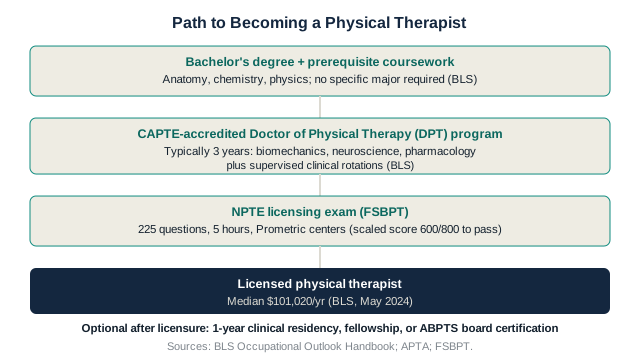
Per the Bureau of Labor Statistics, the typical entry-level education for a physical therapist is a doctoral or professional degree, specifically a Doctor of Physical Therapy (DPT). There is no bachelor's-level or master's-level track left in the United States; anyone entering the occupation today needs the doctorate. BLS does not require a specific undergraduate major to apply to a DPT program, though it notes applicants typically hold a bachelor's degree in a field such as recreation and fitness or a healthcare-related area, along with prerequisite coursework in subjects including anatomy, chemistry, and physics.
The doctoral program itself must be accredited by the Commission on Accreditation in Physical Therapy Education (CAPTE) to qualify a graduate for licensure, according to the American Physical Therapy Association (APTA); APTA does not rank or endorse individual programs, only CAPTE evaluates and accredits them. BLS describes DPT programs as typically running three years and including coursework in biomechanics, neuroscience, and pharmacology, alongside supervised clinical work in settings such as acute care and orthopedic care. Combined with a four-year bachelor's degree, the typical timeline from starting college to finishing the DPT runs around seven years, before a graduate is even eligible to sit for the licensing exam.
Passing the NPTE
Every state requires physical therapists to hold a license, and passing the National Physical Therapy Examination (NPTE) is the exam component of that requirement everywhere. The NPTE is developed and administered by the Federation of State Boards of Physical Therapy (FSBPT), the umbrella body for state licensing boards, not by APTA or by any individual school. Per FSBPT's own Candidate Handbook, the physical therapist version of the exam runs five sections of 45 multiple-choice questions each, 225 questions total, with five hours of testing time (five hours and thirty minutes of total appointment time including a scheduled break). It is computer-based, given at Prometric testing centers, and offered on fixed dates four times a year: January, April, July, and October.
FSBPT converts each candidate's raw score, the number of questions answered correctly, into a scaled score ranging from 200 to 800 so that scores are comparable across different exam forms of varying difficulty. Every state licensing board uses the same passing standard: a scaled score of 600 or higher passes, and the exam is reported as pass/fail rather than as a percentile ranking against other candidates. Beyond the NPTE itself, state requirements vary: per BLS, some states also require a jurisprudence or law exam and a criminal background check before issuing a license, and continuing education is typically required to keep the license active. BLS directs candidates to CareerOneStop for state-specific licensing board requirements rather than publishing a state-by-state list itself, and this article follows the same approach rather than guessing at any one state's rules.
After licensure: residency, fellowship, and board certification
Passing the NPTE and obtaining a state license is what makes someone a practicing physical therapist; everything past that point is optional. Per BLS, some physical therapists apply to a clinical residency program after graduation, typically lasting about a year, for additional training in a specialty area of care, and a smaller number go on to a fellowship in an advanced clinical area after completing a residency.
Separately, physical therapists with sufficient clinical practice hours in a specialty can pursue board certification through the American Board of Physical Therapy Specialties (ABPTS), which APTA describes as the body governing specialist certification and recertification for the profession. Per APTA's specialization program, ABPTS certifies across ten specialty areas, including orthopedics, sports, geriatrics, neurology, and pediatrics, and requires both documented clinical practice in the specialty and a passing score on a written exam. None of this, residency, fellowship, or board certification, is required to work as a licensed physical therapist; it is additional credentialing some practitioners pursue after they are already practicing.
What licensed PTs earn, and how the DPT compares to other advanced-credential health roles
BLS reported a median annual wage of $101,020 for physical therapists in May 2024, with the bottom 10% earning less than $74,420 and the top 10% earning more than $132,500; industry pay also varies, with home healthcare services paying the highest tracked median at $108,110. For the full percentile and industry breakdown, see physical therapist salary.
The DPT puts physical therapy in the same doctoral-entry tier BLS uses for pharmacists, whose Doctor of Pharmacy (PharmD) is likewise a professional doctorate. BLS puts the pharmacist median at $140,910 (its May 2025 figure, against May 2024 for physical therapists), about $39,890 (roughly 39%) above the physical therapist median, despite a broadly similar total years of postsecondary training. By contrast, physician assistants and nurse practitioners typically enter with a master's degree, one credential level below a DPT or PharmD, yet BLS reports higher medians for both roles: $133,260 for physician assistants and $129,210 for nurse practitioners, each above the physical therapist figure. None of this is a claim that a shorter credential path pays better, or that any one of these roles suits a given person more than another; it is simply what BLS reports for each occupation's aggregate labor market. At the opposite end of the training-length spectrum, becoming a CNA requires a federal minimum of 75 hours of training rather than a doctoral degree, with a BLS median of $42,260, about 42% of the physical therapist figure.