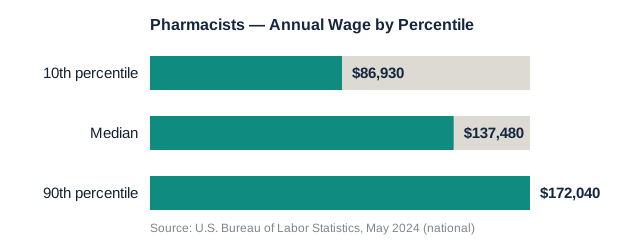
The national numbers
BLS puts the May 2025 median pharmacist salary at $140,910 a year, or $67.75 an hour. Since pharmacists require a Doctor of Pharmacy (PharmD) degree (a professional doctorate that typically takes four years after at least two years of prerequisite coursework), this is one of the higher-paying occupations that does not require a residency or additional post-graduate licensing exam beyond the North American Pharmacist Licensure Examination (NAPLEX) and a jurisprudence exam. By contrast, this site's clinical laboratory technologist salary guide covers a healthcare role that typically requires only a bachelor's degree, with a considerably lower $62,930 median.
The percentile spread is narrower than in occupations like actuarial science: the bottom 10% of pharmacists earned less than $99,290, and the top 10% earned more than $174,230 in May 2025. A roughly $75,000 gap between deciles in a single-credential profession suggests the spread is driven mainly by setting and geography rather than large differences in required qualifications. A comparably tight spread shows up in medical dosimetrist pay, a radiation-oncology specialty with a $147,470 median and a similar roughly $73,780 gap between its own 10th and 90th percentiles.
Retail pharmacy vs. clinical and hospital settings
The industry breakdown clarifies where the money actually is. Hospitals paid the highest median in May 2025 at $157,290. Ambulatory healthcare services, a category that includes outpatient clinics and specialty infusion centers, paid close behind at $153,920. General merchandise retailers, meaning big-box stores with in-house pharmacies, paid $151,370.
Pharmacies and drug retailers, the traditional chain and independent retail pharmacy setting most people picture when they hear "pharmacist," paid a median of $132,940, noticeably below the other three categories despite employing a large share of all pharmacists. For a considerably lower-paid licensed profession outside clinical pharmacy entirely, this site's funeral director salary guide reports a $55,010 median for morticians, undertakers, and funeral arrangers in May 2025.
How long it takes to become a licensed pharmacist
BLS lists at least two years of prerequisite undergraduate coursework (subjects such as anatomy and physiology, physics, and statistics) as the typical entry point for a Pharm.D. program, though many applicants complete a full four-year bachelor's degree before applying, since some schools prefer or require one. The Pharm.D. program itself usually runs four years, so most students spend six to eight years in school total before graduating. The American Association of Colleges of Pharmacy confirms this same structure and notes that a smaller number of programs admit students directly out of high school into six-year combined tracks that fold the prerequisite years and the professional years into one continuous sequence.
Graduating does not mean practicing yet. Every state requires a license, which means passing the NAPLEX plus a state-specific law exam (commonly the MPJE) and logging a state-set number of supervised intern hours, work most students complete during school rather than after. BLS notes this licensing step typically adds a few more months, not years, to the timeline. Pharmacists aiming for a clinical or hospital specialty often add a one- to two-year residency after the Pharm.D., though it is not required to practice in most general pharmacy roles. Outside any clinical licensing track, this site's truck driver salary guide reports a considerably lower $57,440 median for heavy and tractor-trailer drivers in May 2024, with 4% projected growth through 2034.
Job outlook
BLS projects 5% employment growth for pharmacists from 2025 to 2035, classified as faster than average, adding about 17,100 jobs over the decade. That is a more moderate growth rate than several other healthcare occupations on this site, in part because retail pharmacy chains have been consolidating locations in some regions even as demand for clinical pharmacist roles in hospitals and specialty care has grown. A smaller but faster-growing master's-level specialty is covered in this site's genetic counselor salary guide, which reports a $100,040 median and 10% projected growth through 2035.