What genetic counselors earn, and what BLS says they actually do
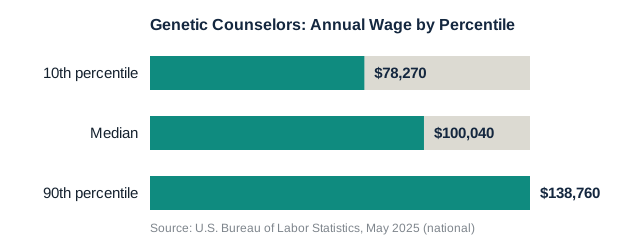
A genetic counselor earned a median of $100,040 a year in May 2025, or $48.09 an hour, per the Bureau of Labor Statistics, which profiles this occupation on its own dedicated page under SOC code 29-9092. The bottom 10% of earners made less than $78,270 a year, while the top 10% made more than $138,760, a spread of roughly $60,490. BLS counted 4,200 genetic counselors nationwide in 2025, a small occupation in headcount terms compared with most of the roles this site tracks.
BLS describes the job itself as assessing a client's risk for inherited conditions, such as birth defects, then reviewing genetic test results with individuals and families and helping them work through decisions based on those results; genetic counselors also pass that information along to other healthcare providers involved in a client's care. Most work full time, primarily in hospitals, physicians' offices, outpatient care centers, university medical centers, and diagnostic laboratories.
Two jobs share the word "counselor" on this site, but not much else
BLS separately tracks school and career counselors and advisors under a different SOC code, with a May 2025 median of $64,330, or $30.93 an hour, $35,710 below what genetic counselors earn. Both occupations typically require a master's degree for entry, and both usually require a state-issued credential to practice, so the pay gap is not a matter of one job asking for more schooling than the other on paper.
What differs is the degree itself and who issues the credential. BLS says school counselors typically need a master's degree in school counseling or a related field, plus a state credential that may be called a certification, a license, or an endorsement, with the specific exam varying by state (many use a Praxis test, though Texas uses its own). Genetic counselors instead need a master's degree specifically in genetic counseling from a program accredited by the Accreditation Council for Genetic Counseling (ACGC), and licensure in most states typically requires passing a national board exam rather than a state-specific one, discussed further below. The two occupations sit in entirely separate parts of BLS's classification system despite the shared job title word, which is a reminder that "counselor" alone does not tell a reader much about degree requirements or pay on this site.
Industry pay spans about $49,000, and physician offices pay the least of the five settings
BLS breaks out May 2025 wages across five industry categories for genetic counselors. Outpatient care centers paid the highest median, at $143,620, followed by medical and diagnostic laboratories at $108,640, private colleges, universities, and professional schools at $106,710, and hospitals (state, local, and private) at $102,140. Offices of physicians paid the least of the five, at $94,380, a gap of $49,240 between the highest- and lowest-paying settings.
That ordering runs counter to an assumption some readers might make, that an individual physician's practice is where genetic counselors are paid the most, since it is a setting closely tied to direct patient care. BLS does not explain the gap on this page; a plausible factor, not a claim BLS itself makes, is that outpatient care centers and larger laboratory or hospital systems may see higher volumes of referred, complex cases and can operate under different compensation structures than an individual physician's practice.
A master's-only field that already out-earns one occupation requiring a doctorate
Per BLS, genetic counselors typically need a master's degree in genetic counseling, and nearly all states require them to be licensed, with licensure usually requiring board certification. BLS does not name the certifying body on its own page; it directs readers to their state's medical board for licensing specifics and separately points to CareerOneStop for certification information. Independently of BLS, that certification is the Certified Genetic Counselor (CGC) credential, issued by the American Board of Genetic Counseling (ABGC) to candidates who complete an ACGC-accredited master's program and pass a 200-question exam (170 scored questions plus 30 unscored pretest items) administered over four hours through the testing company Prometric. The field's primary professional association, the National Society of Genetic Counselors (NSGC), was incorporated in 1979 and remains the largest membership organization for genetic counselors in the U.S. and Canada.
Against other advanced-degree occupations this site tracks, the $100,040 genetic counselor median already beats the $94,310 BLS reports for psychologists, an occupation whose largest specialty group typically requires a doctoral degree rather than a master's (that psychologist figure is for May 2024, the most recently published data on that page, rather than the May 2025 year used above). It still trails physician assistants at $133,260, another occupation that, like genetic counseling, typically enters with a master's degree (also a May 2024 figure). BLS does not explain why two master's-entry occupations land $33,220 apart, or why a master's-only field outpaces one that often requires a doctorate; the comparison describes what each occupation's own BLS profile reports, not a claim that one degree path pays better than another for a given reader.
BLS projects 10% employment growth for genetic counselors from 2025 to 2035, classified as much faster than the average for all occupations, adding an estimated 400 jobs to the 4,200-person 2025 workforce. About 300 openings a year, on average, are projected over the decade, a figure that works out to roughly 3,000 openings across the full ten years against a total net headcount gain of only 400, meaning BLS attributes the large majority of those openings to people transferring to other occupations or leaving the labor force rather than to new positions being created.