The degree BLS says you need depends on the track
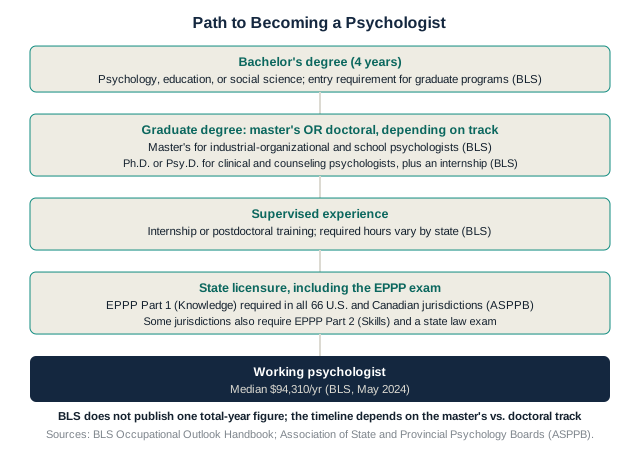
Per BLS, psychologists typically need an advanced degree, either a master's or a doctoral degree, in psychology to enter the occupation. Applicants to graduate-level psychology programs typically come in with a bachelor's degree in a field such as psychology, education, or social science.
Which graduate degree depends on the specialty. Clinical and counseling psychologists, the largest of the four detailed occupations BLS tracks, typically need a Doctor of Philosophy (Ph.D.) or a Doctor of Psychology (Psy.D.). Per BLS, Ph.D. programs usually emphasize research that culminates in a dissertation, while Psy.D. programs focus on applying psychological principles to working with clients or patients, and both typically require students to complete an internship. Industrial-organizational psychologists typically need only a master's degree, with coursework in statistics, research design, and the relationships between people and workplaces. School psychologists also typically need at least a master's degree in school psychology, though some pursue an education specialist (Ed.S.) or a doctoral degree instead; their programs mix education and psychology coursework and, per BLS, usually require an internship too.
Supervised experience, the EPPP, and what license you actually need
Per BLS, most psychologists need supervised experience to qualify for licensure, which may include an internship during the graduate program or postdoctoral training afterward; the required number of hours varies by state. Licensure itself is close to universal: BLS states that all states and the District of Columbia require psychologists who practice independently to be licensed, and that clinical and counseling psychologists specifically are licensed in every state. School psychologists instead typically need a credential from their state's board of education, such as a license or certification, alongside or in place of a standard psychology license. Licensing laws vary by state and by type of position, and BLS directs candidates to their state's licensing board, or to CareerOneStop, a U.S. Department of Labor resource, for the specific requirements.
BLS notes that psychologists must generally pass an exam to be licensed, without naming the exam. Per the Association of State and Provincial Psychology Boards (ASPPB), the organization that develops it, the relevant exam is the Examination for Professional Practice in Psychology (EPPP): all 66 of the U.S. and Canadian jurisdictions ASPPB represents require a passing score on the EPPP (Part 1, Knowledge) before licensure, with a recommended passing score of 500, and some jurisdictions additionally require passing the EPPP (Part 2, Skills). That scope claim comes from ASPPB itself, the exam's own developer; independently, Florida's licensing board confirms on its own site that it requires the EPPP, consistent with ASPPB's account. Which jurisdictions require Part 2, and what other state-specific requirements apply, such as a jurisprudence exam covering state psychology law and ethics, is something ASPPB directs candidates to confirm with the specific licensing board where they intend to practice. All states also require psychologists to complete continuing education to maintain their license, per BLS.
What psychologists actually do, and where the jobs are
Psychologists held about 204,300 jobs in 2024, per BLS, split unevenly across the four detailed occupations: clinical and counseling psychologists accounted for 76,300 of those jobs, school psychologists for 67,200, "psychologists, all other" for 55,300, and industrial-organizational psychologists for just 5,600, the smallest of the four despite posting the second-highest median pay of the four (see below). Clinical and counseling psychologists assess, diagnose, and treat mental, emotional, and behavioral disorders, typically interviewing clients, administering diagnostic tests, and providing psychotherapy to individuals, families, or groups; some states permit them to prescribe medication. Industrial-organizational psychologists apply psychological research to workplace issues such as productivity, employee testing and selection, and organizational dynamics. School psychologists address educational, behavioral, or developmental problems affecting students' learning, designing and evaluating performance plans and consulting with teachers, administrators, and families. The "all other" category covers specialties BLS groups separately, including forensic psychologists, who work with judges and attorneys on the psychological aspects of legal cases, and neuropsychologists, who study how brain, spine, or nerve dysfunction affects behavior and cognition.
Per BLS, the largest employers of psychologists were local elementary and secondary schools (24% of jobs) and ambulatory healthcare services (24%), followed by self-employed workers (23%), government excluding state and local education and hospitals (8%), and hospitals (5%). BLS lists self-employed workers as one of the largest single categories among the occupation's employers, which is consistent with a separate line elsewhere on the same BLS page noting that counseling psychologists often have their own practices.
Pay, by specialty and industry, against other advanced-degree paths on this site
BLS reports a median annual wage of $94,310 for psychologists overall in May 2024, or $45.34 an hour, well above the $49,500 median for all workers that year. The bottom 10% earned less than $54,860, and the top 10% earned more than $157,330, the boundary figures BLS publishes rather than exact percentile values. That overall median blends four detailed occupations with different typical degree requirements and different pay: "psychologists, all other" post the highest tracked median at $117,580, followed by industrial-organizational psychologists at $109,840, clinical and counseling psychologists (the largest single group by headcount) at $95,830, and school psychologists at $86,930, the lowest of the four.
By industry, BLS reports the highest median pay for psychologists in government roles excluding state and local education and hospitals, at $126,990, ahead of ambulatory healthcare services at $96,960, hospitals at $96,060, and local elementary and secondary schools at $85,920, the lowest of the tracked industries despite tying ambulatory healthcare services for the largest employer share, 24% each. BLS projects 6% employment growth for psychologists from 2024 to 2034, faster than the roughly 3% average across all occupations, adding an estimated 11,800 jobs to the 204,300 already employed, with about 12,900 openings projected each year on average, mostly from the need to replace psychologists who transfer to other work or leave the labor force.
Against other advanced-degree occupations this site tracks, the psychologist median trails physician assistants at $133,260, pharmacists at $140,910, and lawyers at $151,160, occupations whose entry requirements range from a master's degree (PA) to two different professional doctorates (PharmD, J.D.). BLS does not break down why these gaps exist across a mix of master's and doctoral entry paths; the comparison describes what BLS's entry-education categories group together, not a claim that any one degree path is the better investment for a given reader. For a comparison outside healthcare and law, this site also covers the degree, path, and pay for becoming a software engineer.