What accountants do, and the degree BLS says you need to start
Per BLS, a bachelor's degree in accounting or a related field is typically required to become an accountant or auditor, with certification in a specific field, such as becoming a licensed CPA, listed as something that may improve job prospects but is not a blanket requirement. BLS groups the work into a consistent set of duties: examining financial statements for accuracy and legal compliance, computing taxes owed and preparing tax returns, inspecting account books and accounting systems for fraud risk, and organizing, analyzing, and maintaining financial records.
BLS also describes several distinct tracks within the occupation. Public accountants, many of whom are CPAs, handle a broad range of accounting, auditing, tax, and consulting work for corporations, governments, individuals, and nonprofits, and some specialize in forensic accounting, investigating financial crimes such as fraud or embezzlement and sometimes testifying as expert witnesses. Management accountants work inside a single organization, helping plan the cost of doing business and analyzing financial information for internal decision-makers. Government accountants examine the records of government agencies or audit private entities subject to government regulation or taxation. External auditors work for an outside firm reviewing another organization's funds, revenue sources, and internal controls, including cybersecurity and supply-chain risk, distinguishing them from internal auditors who do similar work as employees of the organization being reviewed. Only public accountants who work with publicly traded companies face a hard CPA requirement in BLS's description: the SEC requires a CPA's signature on the annual and quarterly reports those companies file.
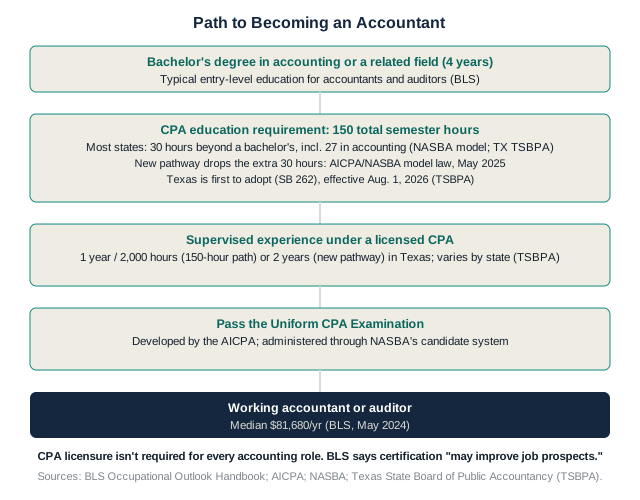
The CPA path: the 150-hour rule, and a new pathway that skips it
BLS's occupational profile does not spell out CPA licensing mechanics beyond naming the credential, so confirming the actual requirements means going to the organizations that set and enforce them. NASBA and AICPA jointly maintain the Uniform Accountancy Act, the model law most states base their CPA rules on, which calls for 150 total semester hours of college credit before licensure, 30 more than the roughly 120 hours a typical bachelor's degree provides. The Texas State Board of Public Accountancy (TSBPA), the state agency that actually issues the license, independently confirms this pattern for one specific jurisdiction: Texas requires a bachelor's degree plus 150 semester hours total, including at least 27 semester hours of upper-level accounting coursework for certification, a three-semester-hour ethics course approved by the board, one year (2,000 hours) of full-time, non-routine accounting work under the direct supervision of a licensed CPA, and passing both the Uniform CPA Examination and a separate exam on the Rules of Professional Conduct. Most states, including Texas, let candidates sit for the CPA exam before finishing all 150 hours, but the license itself isn't issued until every requirement, including the supervised experience, is complete.
That 150-hour rule is no longer the only route, at least in one state so far. AICPA and NASBA's boards of directors jointly approved model legislation in May 2025 adding an alternative CPA pathway: a bachelor's degree with an accounting concentration, two years of supervised experience where the traditional route asks for one, and passing the same Uniform CPA Examination, without the extra 30 credit hours. Individual states still have to enact this themselves, since state legislatures and boards of accountancy, not AICPA or NASBA, control who can actually be licensed in that state. Texas was the first large state to act: Governor Greg Abbott signed Senate Bill 262 into law in May 2025, TSBPA adopted implementing rules that September, and per TSBPA the new pathway opens to candidates on August 1, 2026. Both paths lead to the same CPA license and the same exam; the difference is 30 extra credit hours plus one fewer year of supervised work, which candidates outside a state that has adopted the new pathway won't yet be able to choose.
Where the jobs are, and when the overtime hits
Accountants and auditors held about 1,579,800 jobs in 2024, per BLS. The largest share, 23% of jobs, worked in accounting, tax preparation, bookkeeping, and payroll services, the industry built specifically around this work; government agencies excluding state and local education and hospitals and finance and insurance each accounted for 8%, management of companies and enterprises for 6%, and self-employed workers for 5% of the total.
BLS is specific about the work pattern that makes this occupation different from a typical 9-to-5 role: most accountants and auditors work full time, and overtime hours are typical at certain periods of the year, such as for quarterly audits or during tax season. That seasonal overtime pattern, tied to fixed external deadlines like corporate quarter-ends and the April tax filing deadline, is a structural feature of the industry, and it does not vary mainly by employer the way it might in many other office occupations.
Pay, by industry, against other bachelor's-entry paths on this site
BLS reports a median annual wage of $81,680 for accountants and auditors in May 2024, or $39.27 an hour, well above the $49,500 median across all occupations that year. The bottom 10% earned less than $52,780, and the top 10% earned more than $141,420, the boundary figures BLS publishes, not exact percentile values.
By industry, BLS breaks out May 2024 wages into four categories: finance and insurance paid the highest median at $87,980, followed by management of companies and enterprises at $86,010, government excluding state and local education and hospitals at $81,120, and accounting, tax preparation, bookkeeping, and payroll services, the industry employing the largest single share of accountants (23%), at $80,510, the lowest of the four tracked industries. BLS projects 5% employment growth for accountants and auditors from 2024 to 2034, faster than the roughly 3% average across all occupations, adding an estimated 72,800 jobs to the 1,579,800 already employed, with about 124,200 openings projected each year on average, mostly from the need to replace workers who transfer to other occupations or leave the labor force.
Against other occupations this site tracks, the accountant median sits well below actuaries at $125,770, an occupation whose pay follows a multi-year, exam-based credentialing ladder, and above paralegals at $61,010, an occupation that typically starts with an associate's degree or certificate and that no U.S. state currently licenses. BLS's data describes what each occupation pays, not why the gap between a CPA-track accountant and an actuary runs to more than $44,000 a year even though the CPA route and the actuarial route both run through demanding professional exams; this page reports the pattern rather than asserting a specific cause. This site's guide to becoming a software engineer covers the degree, path, and pay for that occupation.