A wide range, shaped more by credentials than by tenure
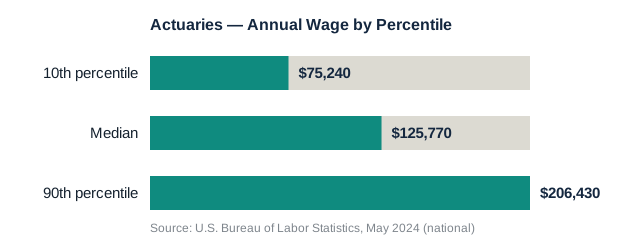
BLS data for May 2024 shows a median annual actuary salary of $125,770, or $60.47 an hour. What stands out in this occupation more than most is the size of the gap between the 10th and 90th percentile: $75,240 at the low end versus $206,430 at the high end, a difference of more than $131,000. That is a wider percentile spread than most professional occupations BLS tracks.
The reason has less to do with geography or employer than with the profession's credentialing structure. Actuaries advance through a series of rigorous exams administered by the Society of Actuaries or the Casualty Actuarial Society, moving from uncredentialed trainee to Associate (ASA/ACAS) and eventually Fellow (FSA/FCAS) status. The Occupational Outlook Handbook notes it can take up to seven years to earn just the associate-level credential, and fellowship requires additional years beyond that. Pay tends to rise sharply at each credentialing milestone; that is the main driver of the wide percentile spread, not simply years spent on the job.
Pay by industry
BLS breaks out May 2024 actuary wages by industry: management of companies and enterprises paid the highest median at $133,030, followed by finance and insurance, the industry most people associate with actuarial work, at $126,830. Government employers (excluding state and local education) paid a median of $118,910, and professional, scientific, and technical services paid $111,640.
This breakdown covers wages only, not headcount by industry; BLS publishes actuarial employment counts by industry separately, in its OEWS industry tables, and that count does not appear on the Occupational Outlook Handbook page cited here. What this wage breakdown does show clearly is that the highest-paying category, management of companies and enterprises, is not the same as "finance and insurance," the industry most people associate with actuarial work by default.
Job outlook and what it means for future pay
BLS projects 22% employment growth for actuaries from 2024 to 2034, classified as much faster than average, adding roughly 7,300 jobs over the decade. That is one of the stronger growth projections among BLS-tracked professional occupations, driven in large part by insurers' and financial firms' growing use of predictive analytics and enterprise risk management, areas where actuarial training applies directly.
Combined with the credential-gated pay structure described above, strong projected demand for a licensed, exam-qualified labor pool tends to support continued wage growth for actuaries who complete the certification track. Still, BLS data describes historical and projected aggregates; it is not a guarantee for any individual.