What the work actually looks like
The Bureau of Labor Statistics describes actuaries as professionals who "use mathematics, statistics, and financial theory to analyze the economic costs of risk and uncertainty." Concretely, that means compiling and analyzing large statistical datasets, estimating the probability and likely cost of events like death, sickness, accidents, or natural disasters, and using those estimates to design insurance policies and corporate risk strategies that price that uncertainty appropriately.
Day to day, an actuary spends time building and refining statistical models, producing charts, tables, and written reports that translate that modeling into recommendations, and presenting those findings to executives, regulators, or clients who are not statisticians themselves. Communication and the ability to explain a model's assumptions in plain terms is a real, non-optional part of the job, not a side skill. For what those executives themselves do, see what a CEO does.
The five main specialty tracks
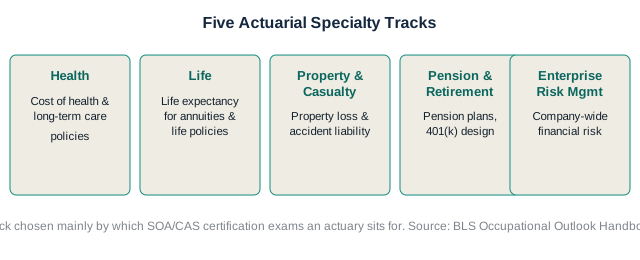
Actuarial work splits into a handful of recognized specialties, each with its own professional exam track. Health insurance actuaries estimate the cost of long-term care and health policies based on factors like family medical history and occupation. Life insurance actuaries build life-expectancy estimates for annuities and life policies, incorporating factors like age and tobacco use. Property and casualty actuaries price policies covering property loss and accident or disaster liability. Pension and retirement benefits actuaries evaluate pension plans and help design retirement benefit structures like 401(k) plans; this track additionally requires licensing through the U.S. Department of Labor and Treasury. Enterprise risk management actuaries take a broader view, identifying financial and economic risks to a company's overall objectives rather than pricing a single product line.
Which track an actuary ends up in is usually determined by which exams they choose to sit for as they progress through certification, more than by their initial job placement. It is common to specialize a few years into a career rather than from day one.
The exam-based path to qualification
Entry typically requires a bachelor's degree in mathematics, actuarial science, statistics, or a related quantitative field, with coursework in economics, applied statistics, and corporate finance. What sets actuarial credentialing apart from most professions is the exam sequence administered by the Society of Actuaries (SOA) or Casualty Actuarial Society (CAS): candidates must pass a series of rigorous, difficult exams plus professionalism seminars to earn Associate-level certification, a process the Occupational Outlook Handbook notes can take up to seven years. Reaching Fellow-level certification, the terminal credential, takes additional years beyond that.
Most employers expect candidates to have already passed one or two exams before graduating college, and new hires typically start as trainees under an experienced actuary's supervision, working on basic data compilation before progressing to independent modeling and report writing as they clear more exams.