What the job actually involves
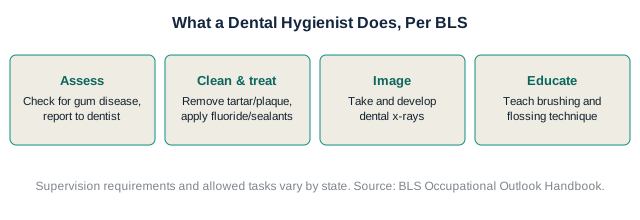
Per BLS, "dental hygienists examine patients for signs of oral diseases, such as gingivitis, and provide preventive care, including oral hygiene." In its longer duties list, BLS breaks that down into a specific set of tasks: removing tartar, stains, and plaque from teeth; applying sealants and fluoride to help protect teeth; taking and developing dental x-rays; assessing a patient's oral health and reporting findings to the dentist; documenting patient care and treatment plans; and teaching patients proper brushing and flossing technique.
BLS also describes the tools involved. Hygienists use hand, power, and ultrasonic instruments, and in some cases lasers, to do the cleaning itself. An air-polishing device, which sprays a mix of air, water, and baking soda, removes stains, while a power tool that works like an automatic toothbrush polishes teeth afterward. X-ray machines are used separately to check for tooth or jaw problems that aren't visible during a routine exam.
How much of that a hygienist can do without a dentist standing over their shoulder, and how far their duties extend, is not the same everywhere. BLS states plainly that "the tasks hygienists may perform, and the extent to which they must be supervised by a dentist, vary by state and by the setting in which the dental hygienist works," and that a few states allow hygienists with additional training, sometimes called dental therapists, to provide limited restorative services such as extracting primary teeth or placing temporary crowns. There is no single national answer to how independently a hygienist practices; it depends on the state's dental practice act.
Where the job happens, and on what schedule
BLS reports that dental hygienists held about 221,600 jobs in 2024, and the setting is heavily concentrated: 94% worked in offices of dentists, with offices of physicians and government employers (excluding state and local education and hospitals) each accounting for roughly 1 percentage point of the total, and the remaining categories BLS doesn't break out individually. Pay tracks that same split closely. BLS's May 2024 industry wage data puts the median at $94,570 in offices of dentists, $84,720 in offices of physicians, and $77,940 in government settings, figures this site's dental hygienist salary guide covers in more detail alongside the full 10th-to-90th-percentile wage range.
BLS also flags that many hygienists work part time, since dentists often hire a hygienist for only a few days a week rather than a full schedule, and it's common for one hygienist to split their time across more than one dental office. That matters for reading the pay figures above: BLS's OEWS wage survey, the same annual survey behind the median figures on this page, assumes a full-time, year-round schedule of 2,080 hours when it converts an hourly wage into an annual one, so a hygienist working three or four days a week should expect real annual earnings below the published median even if their hourly rate matches it.
Job outlook: mostly replacement demand, not new positions
BLS projects employment of dental hygienists to grow 7% from 2024 to 2034, a rate it classifies as much faster than the average for all occupations, adding roughly 15,500 jobs to the current base of 221,600 over the decade. Separately, BLS projects about 15,300 openings for the occupation each year, on average, once the decade is averaged out, a larger number than the net growth figure because most of those yearly openings come from replacing hygienists who transfer to a different occupation or leave the labor force, such as to retire, rather than from newly created positions.
A licensed, degree-gated field growing faster than average tends to keep demand for qualified hygienists high, since the supply of new hygienists is capped by how many people accredited programs can graduate and license each year rather than by how quickly an employer can hire and train someone. That said, BLS's growth projection describes the national labor market in aggregate; it is not a prediction about hiring conditions in any specific city, practice, or year, and a faster-than-average national growth rate does not guarantee an opening exists in a given hygienist's area at a given time.
The path: an associate's degree, then a state license
BLS states that dental hygienists typically need an associate's degree in dental hygiene, with programs usually taking 3 years to complete and combining classroom instruction with laboratory and clinical work. Coursework covers subjects such as anatomy, medical ethics, and periodontics, the study of gum disease. A bachelor's degree is also an option, and BLS notes it, along with a master's, is usually expected for hygienists who go into research, teaching, or clinical practice in public or school health programs, though master's programs in the field remain relatively uncommon. High school students considering the field are pointed toward biology, chemistry, and math coursework, since most dental hygiene programs also require applicants to complete college-level prerequisites before admission, with the specifics varying by school.
Every state requires dental hygienists to be licensed, though the exact requirements vary by state. In most states, that means graduating from an accredited program and passing written and clinical licensing exams, with continuing education required afterward to keep the license active. BLS points readers with state-specific questions to their state's Board of Dental Examiners, or to CareerOneStop for a general overview of state licensing board requirements. Many employers separately require CPR certification on top of the state dental license.
BLS reports a May 2024 median dental assistant wage of $47,300, essentially half the $94,260 hygienist median, and dental assistants can typically enter the occupation through a certificate program of about a year or through employer training alone, without the fixed multi-year, licensing-exam-gated path hygienists go through. BLS's data describes what each occupation pays; it does not break out how much of that roughly two-to-one gap traces to the added years of schooling and the licensing exam specifically versus other factors, such as scope of duties or supervision requirements, and this page reports the pattern rather than asserting a specific cause.