What the job actually involves
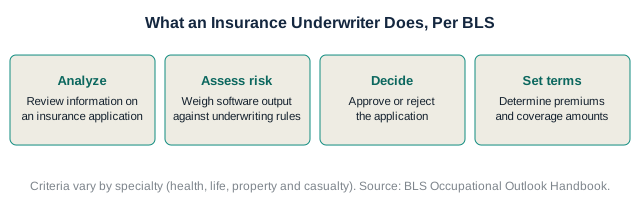
Per BLS, "insurance underwriters evaluate insurance applications and decide whether to approve them." For approved applications, underwriters also determine the coverage amount and the premium the applicant will pay. BLS breaks the role down into a fuller list of tasks: analyzing the information stated on an application, determining the risk of insuring that particular applicant, screening applicants against set criteria, using automated software to help gauge risk, reviewing what that software recommends, contacting field representatives or medical personnel for additional information when needed, deciding whether to offer coverage, and setting the premium and coverage amount once a policy is approved.
Software already does a lot of the first pass. Underwriters enter an applicant's details into a program that returns a recommendation on coverage and pricing, and for common, simple policies such as auto insurance, BLS says underwriters typically rely on that automated recommendation directly. For more complex or unusual coverage, such as workers' compensation, BLS says underwriters lean more on their own analytical judgment; a previous bankruptcy on an application, for instance, might matter a great deal or barely at all depending on how long ago it happened and how the applicant's finances have changed since. Either way, BLS describes the underlying tension underwriters have to manage: approve too much risk and the insurer pays out too many claims, but reject too many applications and it doesn't collect enough in premiums to stay profitable.
Most underwriters specialize in one of three broad fields, per BLS: health, life, or property and casualty insurance. The criteria differ by specialty even though the underlying job duties are similar. A life insurance underwriter weighs an applicant's age and financial history; a property and casualty underwriter evaluating an auto policy weighs the applicant's driving record instead. Within property and casualty specifically, BLS notes underwriters may further specialize by commercial versus personal insurance, or by the type of policy, such as homes, autos, or pets.
Where underwriters work, and what they get paid
BLS reports insurance underwriters held about 127,000 jobs in 2024, almost all of it concentrated in insurance-adjacent industries. Direct insurers other than life, health, and medical carriers employed 52% of underwriters, insurance agencies and brokerages employed 25%, other insurance-related activities employed 5%, direct health and medical insurance carriers employed 4%, and credit intermediation employed 1%. Those five categories BLS breaks out by name account for 87% of the total; BLS doesn't itemize the remaining employers individually. Most underwriters work full time, in an office, and BLS doesn't flag any notable part-time pattern for the occupation the way it does for some other roles on this site.
BLS reports a median annual wage of $79,880 in May 2024, or $38.40 an hour. The spread around that median is wide: the lowest-paid 10% of underwriters earned under $51,640, while the highest-paid 10% earned over $138,020, roughly a 2.7-to-1 gap between the bottom and top of the range. Pay by industry doesn't track employer size the way it does in some other occupations on this site. Credit intermediation, the industry employing the fewest underwriters at just 1%, paid the highest median at $90,000, while direct insurance carriers, the industry employing more than half of all underwriters, paid closer to the middle of the range at $79,350. Other insurance-related activities ($81,870) and direct health and medical insurance carriers ($81,240) both paid above the occupation-wide median as well, with insurance agencies and brokerages at $79,200 rounding out the tracked industries.
Job outlook: one of the rare BLS pages projecting a decline
Most occupations covered on this site show BLS projecting flat-to-positive job growth. Insurance underwriting is an exception. BLS projects employment of insurance underwriters to decline 3% from 2024 to 2034, a loss of about 3,300 positions off the current base of 127,000. BLS attributes the decline directly to automation: "automated underwriting software allows workers to process applications quickly, reducing the need for underwriters," and it expects that software to keep improving and see wider adoption across the insurance industry over the coming decade, which would reduce underwriter headcount further.
Despite the shrinking headcount, BLS still projects about 8,200 openings for insurance underwriters each year, on average, over the decade. BLS is explicit about where those openings come from: every one of them is expected to result from replacing underwriters who transfer to a different occupation or leave the labor force entirely, such as to retire, rather than from newly created positions. That's a different growth story than an occupation like actuary on this site, where BLS projects 22% growth, much faster than average, alongside its own set of replacement-driven openings.
The path in: a degree, but usually no license
BLS states most firms prefer to hire underwriters with a bachelor's degree, commonly in business, with coursework in finance, economics, and mathematics considered helpful. Candidates with only an associate's degree or a high school diploma sometimes qualify if they have relevant insurance work experience, though BLS frames that as an exception rather than the typical path. New hires typically work under a senior underwriter's supervision for up to 12 months, starting on basic applications and moving to more complex ones as they gain experience.
Unlike some licensed occupations on this site, BLS does not describe a state licensing requirement for insurance underwriters. Certification isn't mandatory either, but BLS says employers may expect it, since coursework tied to certification helps underwriters keep up with new insurance products and changes in state and federal regulation. BLS points readers toward CareerOneStop for the range of available certification and specialty-designation options, noting that requirements vary and some credentials require a set number of years of experience before a candidate can pursue them. Advancement follows a similar pattern: experienced underwriters can move up to senior underwriter or underwriter manager, and BLS says certification may be needed to make that move.
BLS's own similar-occupations table puts underwriters next to actuaries, whose $125,770 median pay in May 2024 runs well above the $79,880 underwriter median. The gap tracks a difference in how each field gates entry. Actuaries go through a multi-year professional exam sequence administered by the Society of Actuaries or Casualty Actuarial Society before reaching full certification, a process BLS says can take up to seven years, while underwriters typically clear a bachelor's degree and an employer-run training period with no equivalent exam ladder. BLS's pay data doesn't break out exactly how much of that roughly $46,000 gap owes to the exam-based credentialing itself versus other factors, such as differences in specialization or industry, and this page reports the pay difference rather than asserting a specific cause.