The core of the job
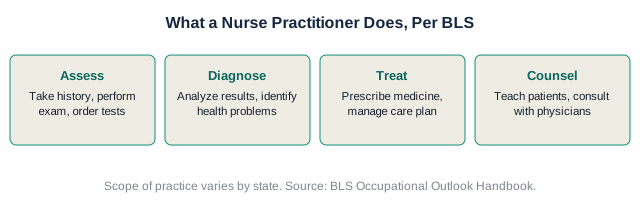
BLS tracks nurse practitioners on a combined occupational profile page shared with nurse anesthetists and nurse midwives, grouping all three together as advanced practice registered nurses (APRNs). Per BLS, APRNs typically take and record patients' medical histories and symptoms, perform physical exams, create or contribute to patient care plans, order and perform diagnostic tests, operate and monitor medical equipment, diagnose health problems, analyze test results and adjust treatment plans as needed, give patients medicines and treatments, evaluate how a patient responds to that treatment, consult with physicians and other healthcare professionals as needed, counsel and teach patients and their families, and, for some, conduct research.
Within that shared duty list, BLS describes nurse practitioners specifically as serving "as primary and specialty care providers, delivering advanced nursing services to patients and their families." NPs assess patients, decide how to improve or manage a patient's health, and work with patients on integrating health-promotion strategies into daily life. Per BLS, nurse practitioners typically focus on a specific patient population, such as adult and geriatric health, pediatric health, or psychiatric and mental health, a specialization that shapes which patients and conditions an individual NP actually sees day to day.
BLS also draws a specific line between this role and registered nursing: nurse practitioners share some duties with RNs, including gathering information about a patient's condition and taking action to manage it, but are trained for tasks RNs are not, including ordering and evaluating test results, referring patients to specialists, and diagnosing and treating health problems.
How much of this an individual nurse practitioner can do without a supervising or collaborating physician depends entirely on the state where they practice. BLS notes broadly that scope of practice for this occupational group varies from state to state; this site's nurse practitioner salary guide covers the state-by-state practice-authority rules in more depth and where to check a specific state's current status.
Where nurse practitioners work, and what the schedule looks like
BLS reports employer data for the combined group of nurse anesthetists, nurse midwives, and nurse practitioners rather than for nurse practitioners alone: offices of physicians employed the largest share at 46%, followed by hospitals at 25%, outpatient care centers at 9%, offices of other health practitioners at 5%, and educational services at 3%. Nurse practitioners made up the largest slice of the underlying 382,700 combined jobs in 2024, at 320,400, so the employer mix likely tracks fairly closely with where NPs specifically work, even though BLS does not publish an NP-only version of this table.
Per BLS, some APRNs provide care in patients' homes, and some may travel long distances to reach patients in areas with a shortage of healthcare workers. This site's nurse practitioner salary guide discusses how that pattern connects to rural and underserved-area demand for NPs in more depth.
Most APRNs work full time, per BLS. Those in physicians' offices typically work standard business hours, while those in hospitals and other healthcare facilities may work shifts, including nights, weekends, and holidays, to cover round-the-clock patient care; some, especially those in critical care settings, are also expected to be on call.
The physical and emotional demands, in BLS's own description
BLS describes this work as both physically and emotionally demanding. Some APRNs spend much of the day on their feet, and lifting and moving patients puts them at risk of back injury. BLS names the emotional weight of the role directly, too: APRNs make critical decisions that affect a patient's health, and that responsibility is itself a source of job stress. Because of the settings they work in, APRNs may also come into close contact with infectious disease and must follow strict guidelines against risks such as accidental needle sticks or a patient outburst.
Physician assistants do similar clinical work (assessing, diagnosing, treating) but under a supervising physician in nearly every state, rather than independently in a majority of them the way many nurse practitioners can. This site's guide to what a physician assistant does covers that role's own duties and setting.