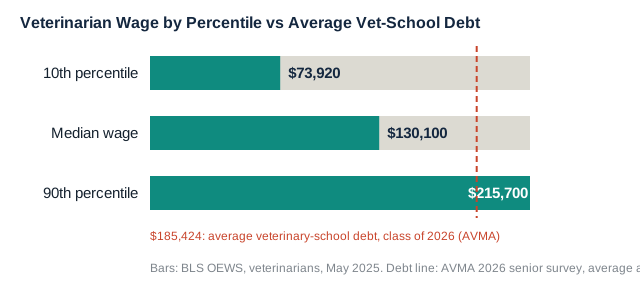
What veterinarians earn, by the numbers
The Bureau of Labor Statistics puts the median annual wage for veterinarians at $130,100 as of May 2025, or $62.55 an hour. That is the midpoint of the occupation: half of the veterinarians in the survey earned more, and half earned less. It sits well above the $50,980 median for all US occupations in the same release, and above the $103,500 median BLS reports for healthcare diagnosing and treating practitioners as a group.
The spread around that midpoint is wide. The lowest-earning 10% of veterinarians made less than $73,920, and the highest-earning 10% made more than $215,700. Just over $141,000 separates the two cutoffs. BLS does not break that difference down by specialty, so the published data does not say how much of it comes from practice type, ownership, region or hours worked.
The occupation behind that one figure is not a single job. The Handbook splits veterinarians into companion animal practitioners, who treat pets in private clinics and hospitals; food animal practitioners, who work with farm livestock and spend much of their time traveling between farms and ranches; and food safety and inspection veterinarians, who test livestock and animal products and enforce food safety rules. Those three groups work in different settings on different schedules, and BLS publishes one national wage estimate for all of them rather than a separate figure for each.
BLS does break wages out by industry, and the industry medians sit closer together than the percentile spread. Social advocacy organizations paid the highest median at $131,760, veterinary services paid $129,990, educational services paid $121,890, and government employers (excluding state and local education) paid $115,210. About 83% of veterinarians worked in veterinary services in 2025, according to BLS, so the industry figure most veterinarians would recognize is the $129,990 one.
Employment was 91,100 in 2025, and BLS projects it to grow 9% between 2025 and 2035, which the agency classifies as much faster than the 3% average for all occupations. That works out to about 3,100 openings a year over the decade, and BLS expects many of them to come from replacing veterinarians who leave the field or retire.
The cost side of the ledger
The credential is a doctoral or professional degree. BLS says veterinarians must hold a Doctor of Veterinary Medicine from an accredited veterinary college and a state license, and it lists no on-the-job training for the occupation. That is the cost side of the question, and BLS does not measure it.
The American Veterinary Medical Association does. Its survey of the class of 2026, presented in October 2026, found average debt from earning a veterinary degree of $185,424 across all graduates, including the ones who finished with none. Among graduates who did carry veterinary-school debt, the average was $227,588. About 18.5% of the class graduated with no veterinary-school debt, while 43.3% owed $200,000 or more and 7.9% owed $400,000 or more.
Against that, the same survey put average compensation for new graduates who had secured full-time employment at $131,784. Graduates entering private practice averaged $133,056 and those entering public practice averaged $101,234. Graduates who went into internships or residencies averaged $59,436 and $54,988 respectively. The AVMA reports an average debt-to-income ratio of 1.5 to 1 for new veterinarians entering full-time work, and says 18.1% of new graduates carry a ratio of 2.5 to 1 or higher.
Why the two figures are not directly comparable
The $130,100 and the $185,424 come from different agencies, different surveys and different kinds of average, so reading them against each other takes a step back.
The BLS figure is a median from the Occupational Employment and Wage Statistics survey, which collects wages from employers. That survey covers wage and salary workers and excludes self-employed workers, owners and partners in unincorporated firms, household workers, and unpaid family workers. BLS counts 7% of veterinarians as self-employed in 2025, and those practice owners are a group the wage survey never sees.
The AVMA figure is a mean from a survey of graduating students, and it counts only debt incurred in veterinary college. It is not a wage, and it says nothing about what a graduate earns in the first year. The AVMA also reports, from its 2026 Census of Veterinarians, an average professional income of $163,014 across all veterinarians for 2025. That number is a mean that includes practice owners, so it sits well above the BLS median for the same period without contradicting it: a mean pulled upward by high-earning owners and a median that leaves them out are two different statistics.
Put plainly, the salary figure most people find first is the wage-and-salary midpoint, and the debt figure is an average that includes graduates who borrowed nothing. Neither is wrong, and neither settles the question on its own.
What the numbers do not settle
BLS does not rank occupations by whether they are worth entering, and its wage survey does not track what any individual owes or earns. What the published data shows is the range. A veterinarian at the 90th percentile earns nearly three times what one at the 10th percentile does, and a graduate who borrowed $400,000 starts from a different place than one who borrowed nothing, even when both are paid the median.
Two things in the BLS profile bear on the decision and are easy to miss. The first is the schedule. BLS says most veterinarians work full time, often more than 40 hours a week, and that some work nights or weekends and may have to respond to emergencies outside scheduled hours. The second is the load. BLS notes that veterinarians working with frightened or injured animals risk being bitten, kicked and scratched, that they can be infected by diseased animals, and that the work can be emotionally stressful because it involves abused animals, euthanasia and supporting anxious owners.
Those are descriptions of the occupation, not predictions about any person. The figures above describe national averages for a group; they do not say what a specific graduate in a specific practice in a specific state will earn or owe. For the wage side on its own, this site's veterinarian salary breakdown works through the percentiles and industry medians in more detail, and the veterinary technician salary guide covers the two-year route into the same clinics at a different credential level. Optometrist pay is a comparison point for another doctoral-level health role with a different debt profile.