The core of the job
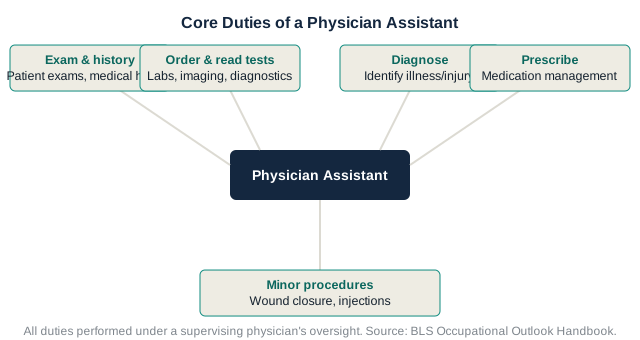
According to the Bureau of Labor Statistics, physician assistants "examine, diagnose, and treat patients under the supervision of a physician." In practice that covers a broad set of clinical tasks: taking medical histories, performing physical exams, ordering and interpreting diagnostic tests like bloodwork and imaging, diagnosing illnesses and injuries, developing treatment plans, prescribing medication, and performing minor procedures such as wound closure or joint injections. For a very different quantitative role that does not involve direct patient contact at all, this site's guide to what actuaries do covers how actuaries use math and statistics to price risk for insurers and pension funds.
PAs also spend a meaningful share of time on tasks that look less clinical but are core to the job: documenting visits, coordinating with other members of a care team, and patient education, walking someone through a diagnosis, medication instructions, or a treatment plan in plain language. That last part is often underestimated by people outside healthcare.
The specific scope of what a PA is allowed to do varies by state law and by the supervising physician's practice agreement. Some states grant PAs broader independent authority than others, and scope of practice has been an active area of state-level legislative change in recent years, so the exact autonomy a PA has in one state may differ from another. Nurse practitioners face a closely parallel pattern, covered in this site's guide to what nurse practitioners do, where scope of practice likewise varies by state law rather than by a national standard.
Where PAs work
PAs work across nearly every medical specialty rather than one fixed setting. BLS names primary care and family medicine, emergency medicine, and psychiatry as common placements, and separately notes that PAs also work in specialties such as surgery and pediatrics. This is one of the appeals of the role for many who choose it over becoming a physician or nurse practitioner: a PA's generalist training makes it possible to move between specialties over a career without going back for an entirely new credential, something that is much harder for a physician who has completed specialty-specific residency training. Compared with PAs moving across specialties, this site's dental hygienist duties guide describes a role where, per BLS, 94% of the workforce works in a single setting, dentists' offices.
The industry wage breakdown reflects that range of settings. BLS reports a May 2024 median PA salary of $133,260 nationally, with government employers paying the highest median among tracked categories at $151,470, followed by outpatient care centers ($147,650), hospitals ($136,630), and physician offices ($129,640). At a far less credentialed tier of patient-facing work, this site's home health aide duties guide reports a median wage of $35,800 for a role with no required degree or national certifying exam.
Education and licensing path
Becoming a PA requires a master's degree from an accredited physician assistant program, which typically takes at least two years beyond a bachelor's degree and combines classroom instruction with supervised clinical rotations across multiple specialties. Most programs expect applicants to already hold a bachelor's degree with substantial science coursework and hands-on patient-care experience (commonly as a medical assistant, EMT, paramedic, or in a similar clinical support role) before admission.
After completing a program, candidates must pass the Physician Assistant National Certifying Examination (PANCE) to earn the PA-C (Physician Assistant-Certified) credential, and every state requires PA licensure on top of that national certification. Maintaining certification requires ongoing continuing medical education and periodic recertification exams. By contrast, this site's overview of paralegal duties covers a legal-support role that, per BLS, requires no license or national certifying exam to practice.