What millwrights actually do, per BLS
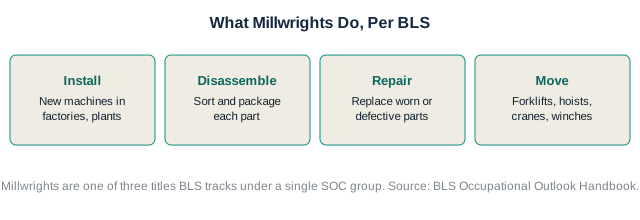
BLS groups millwrights with industrial machinery mechanics and machinery maintenance workers under one occupation, Industrial Machinery Mechanics, Machinery Maintenance Workers, and Millwrights (the millwright-specific SOC code is 49-9044), but it describes each of the three titles separately in its What They Do section. Per BLS, "millwrights install, maintain, and disassemble industrial machines." Putting together a single machine can take a few days or several weeks. Millwrights carry out repairs by replacing worn or defective parts, and they're also the ones called in when a manufacturing plant needs to clear floor space for new equipment: BLS says millwrights disassemble the entire machine, then "carefully disassemble, categorize, and package each part."
BLS draws a clear line between millwrights and the other two titles in the group. Industrial machinery mechanics, per BLS, use technical manuals and computerized diagnostic tools to figure out why a machine already running has failed, for example tracing a vibration to worn belts or weak motor bearings, then take it apart to repair or replace the failed component. Machinery maintenance workers handle lighter, routine work: cleaning, lubricating, and running basic diagnostic tests, leaving major repairs to the mechanics. Millwrights differ from both in scope. They're the ones who install a new machine in the first place, and when a machine needs to be relocated or taken apart entirely, they use tools that scale to the job, from cranes, forklifts, hoists, and winches on large projects down to hand tools such as hammers and levels, plus precision-measuring devices like micrometers and lasers for smaller work.
The entry path: an apprenticeship, not a degree
BLS states that industrial machinery mechanics, machinery maintenance workers, and millwrights typically need only a high school diploma or equivalent to enter the occupation, but the training path splits from there. Machinery maintenance workers usually receive a few months to a year of on-the-job training. Industrial machinery mechanics typically get more than a year of on-the-job training. BLS notes that some mechanics and millwrights alike complete a 2-year associate's degree program in industrial maintenance first, covering courses such as welding, math, hydraulics, and pneumatics, though it isn't a requirement for either. The standard path for millwrights specifically, per BLS, is that they "learn their trade through a 3- or 4-year apprenticeship." Each year of that program requires at least 144 hours of related technical instruction plus up to 2,000 hours of paid on-the-job training, split between classroom subjects such as welding, blueprint reading, math, and machinery troubleshooting, and supervised work setting up, cleaning, lubricating, repairing, and starting machinery. BLS lists the basic qualifications for entering an apprenticeship as a minimum age of 18, a high school diploma or equivalent, and being physically able to do the work, with employers, local unions, contractor associations, and state labor departments typically sponsoring the programs. Once a millwright completes the apprenticeship, BLS says they are considered fully qualified and can perform tasks with less supervision.
That apprenticeship structure puts millwrights in the middle of the no-degree trades this site tracks. It runs a year shorter than the plumbing apprenticeship, which this site's BLS-sourced data puts at 4 to 5 years with roughly 2,000 paid hours a year, and shorter than the 4- or 5-year apprenticeship BLS describes for electricians, which likewise runs about 2,000 paid hours per year. It's also more structured than the path into welding, where BLS describes several viable entry routes side by side (vocational school, employer apprenticeship, military training, or direct hire with on-the-job training) rather than one standard apprenticeship length. For the day-to-day duties on the welding side, see what a welder does.
Pay: a millwright-specific figure inside a combined BLS page
BLS reports a median annual wage of $63,510 for the combined group, Industrial Machinery Mechanics, Machinery Maintenance Workers, and Millwrights, in May 2024. Inside that combined figure, BLS breaks median pay out by the three individual titles: millwrights earned a median of $65,170, above industrial machinery mechanics at $63,760 and machinery maintenance workers at $60,500. What BLS does not break out by title is the 10th and 90th percentile range or the industry-by-industry wage table. For the combined group as a whole, the bottom 10% earned less than $44,430 and the top 10% earned more than $91,620, a spread of roughly 2 times between the two boundary figures, but that range describes all three titles together, not millwrights specifically. The same caveat applies to the industry breakdown: manufacturing paid the highest median for the combined group at $64,360, followed by construction at $62,920, wholesale trade at $61,940, and the repair-and-maintenance services industry at $60,490, again without a millwright-only figure inside each industry.
Against other no-degree apprenticeship trades this site tracks, the millwright median lands above electricians at $62,350 and plumbers, pipefitters, and steamfitters at $62,970, and well above welders, cutters, solderers, and brazers at $51,000, a gap of more than $14,000. BLS's data describes what each occupation pays; it does not explain why the shorter millwright apprenticeship pairs with pay above two trades that require a longer one, and this page reports the pattern rather than asserting a specific cause. This site's how to become a lineman guide covers the apprenticeship, CDL, and pay for a further trade in this group.
Job outlook: flat for millwrights, even as the wider group grows
BLS projects overall employment for the combined group, industrial machinery mechanics, machinery maintenance workers, and millwrights, to grow 13% from 2024 to 2034, much faster than the roughly 3% average across all occupations, with about 54,200 openings projected each year on average across the whole group. Millwrights specifically do not share in that growth. BLS's own projections table shows millwright employment holding flat at 41,300 jobs in both 2024 and 2034, a 0% change that falls into the "little or no change" band on BLS's growth-rate classification scale (an increase of less than 1% to a decrease of less than 1%), out of 41,300 millwrights within the larger 538,300-person combined workforce. Industrial machinery mechanics, the largest of the three titles at 439,600 workers, account for nearly all of the group's projected growth, up 16% to 510,300; machinery maintenance workers are projected to shrink 3%, to 55,900.
BLS attributes the flat millwright number to the specific industries that employ them. Millwrights' employment, per BLS, "is affected by the slower growth of the industries in which they are employed, such as paper mills." BLS also points to slower expected job growth in nonresidential construction, since the facilities built there are less likely to require a millwright, as a second drag on the number. That combined-group total of 54,200 annual openings is not broken out by title either, so this page does not attribute a specific annual-openings figure to millwrights alone. For context on what drives growth elsewhere in the group, BLS credits continued adoption of automated manufacturing machinery and expanded use of automated conveyors, both of which need regular upkeep, with creating jobs for industrial machinery mechanics specifically.