What BLS says about entry, and what two apprenticeship sponsors actually require
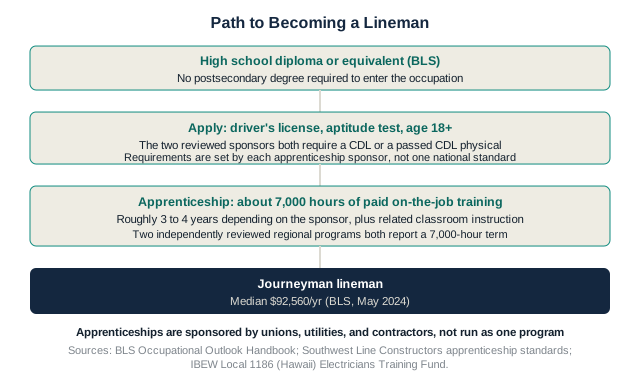
Per BLS, electrical power-line installers and repairers typically need a high school diploma or equivalent to enter the occupation. Workers become proficient through technical instruction and on-the-job training, and BLS notes apprenticeships are common, but its Occupational Outlook Handbook page for this occupation does not publish a specific apprenticeship length or hour requirement the way it does for some other trades. Confirming what an apprenticeship actually looks like requires going to the organizations that run them.
Apprenticeships in this trade are sponsored by individual unions, utilities, and contractor associations; there's no single national program setting the terms, so the specific numbers vary by sponsor. Two regional programs reviewed directly for this page, Southwest Line Constructors, which serves apprentices in Arizona, New Mexico, Kansas, Oklahoma, and parts of Texas, and the IBEW Local 1186 training fund in Hawaii, both describe a term of about 7,000 hours of on-the-job training. Southwest Line Constructors states this term "may require more than three and one half years to complete in view of possible employment lapses," plus three years of related classroom instruction away from the job. The Hawaii program describes essentially the same 7,000-hour on-the-job total as running "approximately 3 years," supplemented by 480 hours of related classroom instruction. The two sponsors land on similar on-the-job hour totals but different stated timelines and classroom-hour figures, a real difference in how each program structures and counts the work, not a mistake in either one.
Southwest Line Constructors' published apprenticeship requirements include being at least 18 years old, holding a Class A commercial driver's license, passing an aptitude test, passing a medical exam, and paying an application fee. The Hawaii program's listed requirements include a valid driver's license and passing a CDL physical, without specifying a CDL class in the page reviewed for this article. Both point to the same practical reality BLS hints at with "apprenticeships are common": entry into this trade runs through a sponsor's apprenticeship program, not a single standardized credential, so the specific requirements to confirm are whichever sponsor's program someone intends to apply to.
The work itself: what BLS lists as the core hazards and required qualities
BLS's own Work Environment summary for this occupation is blunt about the risks: electrical power-line installers and repairers "encounter serious hazards on the job, including working with high-voltage electricity, often at great heights," and the work "also can be physically demanding." Most work full time, and some work more than 40 hours a week; BLS also notes that in emergencies or after storms and other natural disasters, workers may have to travel to affected areas and work long hours for several days in a row.
BLS lists a specific set of qualities important for the job: the ability to work at heights from ladders or bucket lifts while climbing utility poles, color vision to distinguish color-coded wires and cables, interpersonal skills because crew members rely on each other for safety, physical stamina to climb poles carrying heavy tools, physical strength to lift heavy cables and equipment, problem-solving skills to diagnose faults in electrical systems, and technical skills to operate diagnostic equipment on circuits. None of this is a substitute for an employer's own physical or medical requirements, which BLS's occupational profile does not itemize beyond these general categories.
What linemen actually earn, by percentile and industry
BLS reports a median annual wage of $95,320 for electrical power-line installers and repairers in May 2025, or $45.83 an hour, well above the $50,980 median across all occupations that year. The bottom 10% earned less than $51,470, and the top 10% earned more than $128,690, a spread of more than $77,000, or more than 2.5 times, between the boundary figures BLS publishes.
By industry, BLS breaks out May 2025 wages into five categories. Federal government employers paid the highest median at $111,900, followed by utilities at $103,060, local government excluding education and hospitals at $90,060, specialty trade contractors at $76,980, and utility system construction, the lowest of the five tracked categories, at $76,060. BLS does not explain what drives that industry ordering, though whether the employer is a federal agency or utility directly operating the grid, or a contractor building or maintaining it under contract, is one plausible distinction worth confirming against a specific job offer, not assumed from the industry label alone.
Job outlook, and how this pay compares with other no-degree trades on this site
BLS projects employment of electrical power-line installers and repairers to grow 10% from 2025 to 2035, a rate it classifies as much faster than the average for all occupations, adding an estimated 13,600 jobs to the 131,900 already employed in 2025. About 10,900 openings are projected each year on average over the decade, though BLS attributes many of those to the need to replace workers who transfer to other occupations or exit the labor force, such as to retire, rather than to newly created positions alone.
Against other no-degree, apprenticeship-based trades this site tracks, all of which BLS also lists as requiring only a high school diploma or equivalent to enter, the lineman median sits well above electricians at $63,190, plumbers, pipefitters, and steamfitters at $63,800, and welders, cutters, solderers, and brazers at $53,750, a gap of more than $31,000 in every comparison and above $41,000 against welders specifically. BLS does not state why line work pays more within this cluster of similarly credentialed occupations, and the page's Similar Occupations table lists power plant operators, distributors, and dispatchers, another high school diploma occupation, at a comparably high $103,600 median, while electricians on the same table sit far closer to welders and plumbers than to either line work or power plant operations. That comparison table is consistent with the two occupations that carry the clearest physical exposure to high-voltage electricity commanding the highest pay in the group, but BLS's data describes what employers pay, not why, and this page reports the pattern without claiming a specific cause. Millwrights, another trade this site covers, have their own duties, path, and BLS pay data page.