Two apprenticeship routes into the trade
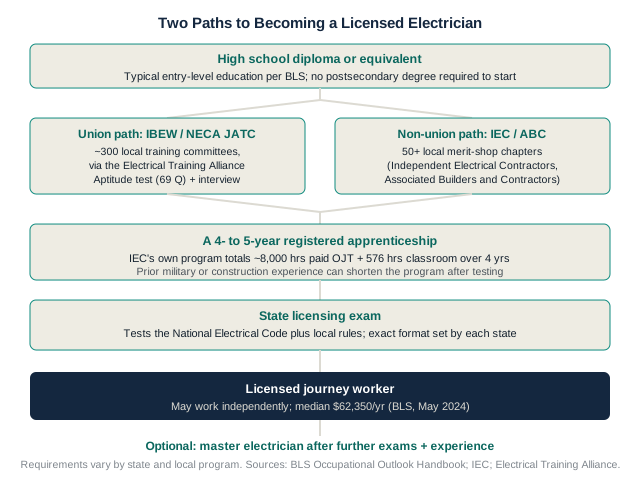
Per BLS, the entry-level education for electricians is a high school diploma or equivalent, with the trade itself learned through a paid apprenticeship, not a postsecondary degree. Applicants generally choose between two structurally different routes to get there: a union path or a non-union path, and the choice mostly determines who runs the training and where a person ends up working, not how many hours the program eventually requires.
The union route runs through the International Brotherhood of Electrical Workers (IBEW) and the National Electrical Contractors Association (NECA), which jointly operate roughly 300 local Joint Apprenticeship and Training Committees (JATCs) under a shared training arm called the Electrical Training Alliance, formerly known as the National Joint Apprenticeship and Training Committee. Getting in usually requires passing the Electrical Training Alliance Aptitude Test, a proctored exam covering algebra and functions plus reading comprehension across 69 questions in about 97 minutes, scored on a 1-to-9 stanine scale. Most locals require at least a 4 to move on to a separate, also-scored interview, and the two scores together decide who is offered a spot.
The non-union route runs through Independent Electrical Contractors (IEC), a nonprofit trade association for merit-shop contractors with more than 50 local chapters, and through similar programs run by Associated Builders and Contractors (ABC) chapters. Entry requirements are set locally, not through one national exam, and typically include a high school diploma and proof of basic algebra coursework; some chapters use their own placement screening, but not the centralized aptitude test IBEW/NECA locals share. Both the union and non-union tracks register with the U.S. Department of Labor's Office of Apprenticeship under the same electrician occupation code, 47-2111.00, so from a federal standpoint they carry the same underlying credential even though the application process differs.
What IEC's roughly 8,000 hours actually cover
IEC publishes its apprenticeship structure as 144 hours of classroom instruction per year, 576 hours total, alongside 2,000 hours of documented, paid on-the-job training per year, 8,000 hours total, spread across a four-year program; the figure is repeated consistently across more than half a dozen independent local IEC chapter sites. BLS describes JATC programs in similar terms, noting about 2,000 hours of paid on-the-job training per year alongside technical instruction covering electrical theory, blueprint reading, and code requirements, without publishing IBEW/NECA's own classroom-hour total on the same page.
BLS notes that workers who already have electrical experience from the military or from construction work, or who complete a technical school program first, may qualify for a shortened apprenticeship after testing into the program at an advanced level. Neither BLS nor the trade associations describe this as a fast track available to everyone; it depends on documented prior experience being accepted by the specific program.
On pay during the apprenticeship, BLS states only that apprentices earn less than fully trained electricians and that pay rises as they take on more responsibility over the course of the program; the Occupational Outlook Handbook does not publish a specific apprentice wage schedule separate from the fully qualified median covered below, and this article does not estimate one where BLS itself does not.
Getting licensed after the apprenticeship
Completing an apprenticeship makes someone a journey worker, per BLS, who may perform electrical work independently, subject to state or local licensing requirements. Most states require passing a licensing exam before a journey worker can operate on their own, and the exams generally test knowledge of the National Electrical Code alongside state and local building codes.
PSI Services LLC administers the electrical licensing exam for a number of state boards, including Texas, North Carolina, Washington, Virginia, and Nebraska, though each state sets its own exam format; there is no single shared national test. Virginia, for example, requires a 70-question, 210-minute journeyman exam and a 70% score (49 correct answers) to pass, per the state's Department of Professional and Occupational Regulation; that specific format is Virginia's own published requirement and should not be assumed to carry over to other states. Texas, by contrast, split its journeyman exam into two separately timed sections in March 2025, an NEC-knowledge portion and a calculations portion, each requiring its own 70% score.
BLS directs readers to CareerOneStop for state-by-state licensing board information, without listing every state's requirements on its own page, and this article follows the same approach, declining to guess at rules for a specific state. In states that recognize a master electrician tier, reaching it typically requires several more years of experience as a licensed journey worker plus a separate exam, a pattern this site's plumbing apprenticeship guide lays out for plumbers, where a further exam after additional years on the job leads to master status.
What the work pays once you are licensed
BLS reported a median annual wage of $63,190 for electricians in May 2025, or $30.38 an hour, with the bottom 10% of earners making less than $42,640 and the top 10% making more than $108,510. Government employers, excluding state and local education and hospitals, paid the highest median at $79,820, while electrical contractors, the industry employing 66% of electricians, paid closer to the occupation-wide median at $61,570. BLS projects 9% employment growth from 2025 to 2035, which it classifies as much faster than average; for a full percentile and industry breakdown, see electrician salary.
Against other no-bachelor's-degree apprenticeship trades this site has covered, electricians land close to the top. Plumbers, pipefitters, and steamfitters post a similar median of $63,800 after a comparably structured 4- to 5-year apprenticeship, while welders have a lower median and multiple non-apprenticeship entry routes BLS describes side by side. Becoming a CNA sits at the opposite end of the training-length spectrum, a federal minimum of 75 hours, not a multi-year apprenticeship, with a median of $42,260, well below any of the trades above. This site's guide to what a welder does covers that trade's duties and safety, and HVAC certification covers EPA 608 requirements, training, and pay for another trade in this group. The rest of WageLark's How to Become hub covers apprenticeship and certification paths for other trades.