EPA Section 608: the certification federal law actually requires
Every HVAC technician needs one federal credential before touching refrigerant: EPA Section 608 Technician Certification. Under 40 CFR Part 82, Subpart F, the U.S. Environmental Protection Agency requires anyone who attaches or detaches hoses and gauges to measure refrigerant pressure, or who adds or removes refrigerant from an appliance, to hold that certification before doing the work. The EPA defines four types of certification: Type I for servicing small appliances, Type II for high- and very-high-pressure appliances (most residential and light-commercial air conditioning falls here), Type III for low-pressure appliances, and Universal, which covers all three and requires passing every underlying test.
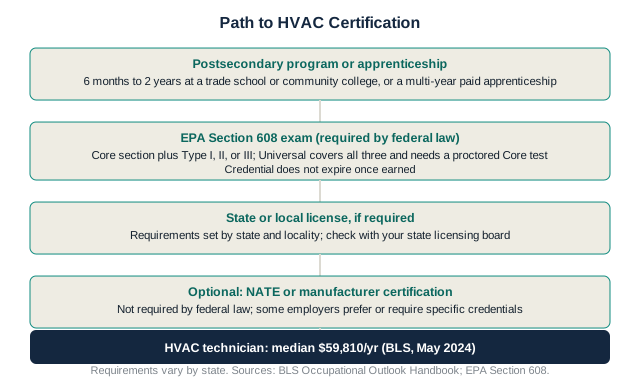
Each certification type requires passing a Core exam plus the type-specific test, both administered by an EPA-approved certifying organization; the tests are typically bundled into the postsecondary HVACR programs described below. One detail trips people up: the EPA specifies that Core exams taken open-book cannot be used toward a Universal certification. A candidate aiming for Universal has to sit the Core section as a proctored exam. Once earned, Section 608 Technician Certification does not expire, unlike many state trade licenses that require periodic renewal. The EPA also carves out an exemption for apprentices, who can perform the same refrigerant-handling tasks without holding the certification themselves as long as a certified technician closely and continually supervises them.
The training that comes before the exam
Per BLS, HVAC technicians typically need a postsecondary nondegree award, though some enter with less education. Most get there through technical or trade schools and community colleges offering programs in heating, air conditioning, and refrigeration; BLS describes these programs as running 6 months to 2 years and leading to either a certificate or an associate's degree. Some employers will consider a candidate whose highest credential is a high school diploma, and BLS specifically recommends vocational education, math, and physics coursework for high schoolers weighing this path.
A smaller share of technicians train through an apprenticeship instead, which BLS describes as usually running several years and combining paid on-the-job training with technical instruction each year, covering topics such as safety practices, blueprint reading, and heating and cooling systems. Either route, newly hired technicians start on basic tasks like insulating refrigerant lines or cleaning furnaces before moving on to harder work such as cutting and soldering pipes or checking electrical circuits, per BLS.
Beyond the federally required EPA exam, some states and localities layer on their own licensing requirements; BLS directs readers to CareerOneStop's licensing tool rather than listing every jurisdiction's rules on one page, and this article does the same rather than guessing at a specific state's process. Manufacturer and industry certifications, such as those from North American Technician Excellence (NATE) or HVAC Excellence, are optional under federal and most state law, though BLS notes some employers prefer or require specific ones. A driver's license is also typically needed, since most technicians travel between jobsites.
What HVAC technicians earn once certified
BLS reported a median annual wage of $59,810 for heating, air conditioning, and refrigeration mechanics and installers in May 2024, or $28.75 an hour. The bottom 10% earned less than $39,130, and the top 10% earned more than $91,020, a roughly $52,000 spread that reflects differences in experience, certification level, region, and employer, not any single factor BLS isolates. For comparison, BLS puts the broader installation, maintenance, and repair occupational group at a median of $58,230, and the median across all occupations in the economy at $49,500; HVAC technicians sit modestly above both.
BLS breaks out May 2024 wages by industry into four tracked categories. Wholesale trade paid the highest median at $65,760, followed by educational services (state, local, and private) at $60,960 and retail trade at $60,730. Plumbing, heating, and air-conditioning contractors, the industry that employs 70% of technicians in this occupation, paid the lowest of the four tracked categories, $58,750, close to but below the occupation-wide median.
Job outlook, and how it compares to other trades
BLS projects 8% employment growth for heating, air conditioning, and refrigeration mechanics and installers from 2024 to 2034, which it classifies as much faster than average, adding an estimated 34,500 jobs and about 40,100 openings a year on average over the decade. As with most occupations BLS tracks, many of those annual openings are expected to come from workers who transfer to other occupations or leave the labor force, such as to retire, rather than from newly created positions alone. BLS attributes underlying demand to commercial and residential building construction plus a growing number of sophisticated climate-control systems that need installing and servicing, along with rising emphasis on energy efficiency driving retrofits and replacements.
Against other no-bachelor's-degree trades this site has covered, HVAC's 8% growth rate trails the 9% BLS projects for electricians, but comfortably outpaces the 4% BLS projects for plumbers, pipefitters, and steamfitters. On pay, HVAC's $59,810 median trails both of those trades, whose medians run in the low $62,000s after a comparably structured multi-year apprenticeship. Becoming a CNA sits at the far end of the training-length spectrum, a federal minimum of 75 hours rather than a postsecondary program or apprenticeship, with a median of $42,260, well below any of the trades above. BLS data describes the aggregate labor market for each occupation; it is not a claim that any one path pays better for a specific person once local demand, certification level, and years of experience are factored in. What a millwright does, another trade this site covers, has its own duties, path, and BLS pay data page.