The "2-year" associate degree is usually a 4-year timeline
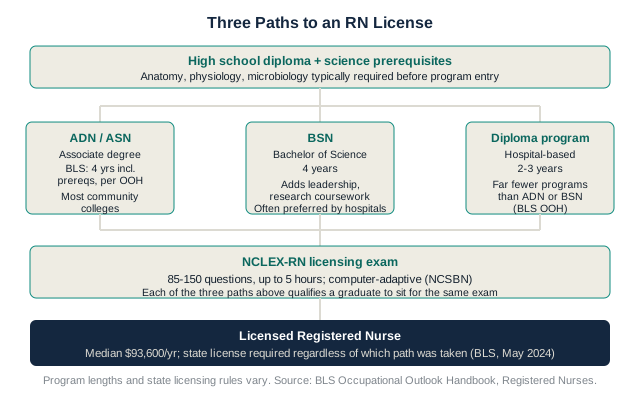
Per the Bureau of Labor Statistics Occupational Outlook Handbook, registered nurses usually take one of three education paths: a bachelor of science in nursing (BSN), an associate's degree in nursing (ADN) or associate of science in nursing (ASN), or a diploma from a hospital-based program. All three include supervised clinical experience alongside classroom coursework in subjects such as anatomy, physiology, microbiology, and social and behavioral sciences.
The part that surprises a lot of people planning this out: BLS describes the ADN and ASN, credentials most people think of as a 2-year degree, as typically taking about 4 years to complete, the same figure BLS gives for a BSN. The reason is prerequisites. Community college nursing programs generally require a set of science courses, such as anatomy and microbiology, completed before a student is even eligible to start the core nursing curriculum, and BLS folds that prerequisite time into its 4-year estimate rather than counting only the nursing-specific coursework. A diploma program, offered by hospitals or medical centers rather than colleges, typically runs 2 to 3 years, but BLS notes there are far fewer diploma programs left than there are BSN, ADN, or ASN programs.
Getting into a program in the first place is a separate hurdle from the timeline itself, and BLS's Occupational Outlook Handbook doesn't cover admissions criteria. Per NurseJournal, an established nursing-education resource, requirements vary by program type and how competitive a given school is: associate degree (ADN) programs typically set a GPA floor between 2.0 and 2.75, though more competitive ones look for 2.5 to 3.5, while bachelor's (BSN) programs generally set a 3.0 minimum, with more selective schools expecting 3.25 or higher. Programs commonly weigh grades in prerequisite science courses, such as anatomy and microbiology, separately from overall GPA, so a strong overall record paired with weak science grades doesn't carry the same weight as consistent performance across both. Some programs also require a standardized entrance exam, the TEAS or HESI, though a number of accredited programs have dropped that requirement in favor of weighing GPA, essays, and interviews instead.
Same license at the end, different hiring odds along the way
BLS is explicit that graduates of any of the three paths, bachelor's, associate's, or diploma, qualify for entry-level positions as a staff nurse once licensed. The credential level does not gate the base RN license itself. What it does affect is who is willing to hire a given candidate: BLS notes that employers, particularly hospitals, may require a bachelor's degree specifically, even though an ADN or diploma graduate holds the identical state license.
For someone who starts with an ADN, ASN, or diploma and later wants the BSN a hospital is asking for, BLS points to RN-to-BSN bridge programs built for exactly that situation, letting a working RN add the bachelor's credential without repeating the associate-level coursework. Separately, BLS lists accelerated programs for career changers who already hold a bachelor's degree in an unrelated field, and combined bachelor's-and-master's tracks for students who know from the start they want to go past entry-level RN.
Passing the NCLEX-RN, and what state licensing actually adds
Finishing an education program is not the last step. Every state requires registered nurses to hold a nursing license, and per BLS, becoming licensed requires graduating from an approved nursing program and passing "a qualifying exam," the NCLEX-RN. The exam itself is developed and administered by the National Council of State Boards of Nursing (NCSBN), the body that represents state nursing boards, not by any individual school or program. Per NCSBN's own published exam details, the NCLEX-RN is a computer-adaptive test that runs a minimum of 85 and a maximum of 150 scored and experimental items combined, with a total appointment time, including the introductory screen and any breaks, capped at 5 hours.
Passing the NCLEX-RN is not the entire licensing requirement on its own. BLS notes that other requirements, such as a criminal background check, vary by state, and directs candidates to each state's board of nursing, or to CareerOneStop's licensing lookup tool, for the specific rules where they plan to work. Separately, BLS notes that many registered nursing positions require CPR, basic life support (BLS certification, not the agency), or advanced cardiac life support certification as a condition of employment, on top of the state license itself, and that further voluntary certification through professional associations, in areas such as ambulatory care, gerontology, or pediatrics, is available and sometimes required by individual employers even though it is not part of state licensure.
What the license is worth, and where it can lead
BLS reports a median annual wage of $93,600 for registered nurses in May 2024 ($66,030 at the 10th percentile and $135,320 at the 90th). Pay varies by setting: government employers outside state/local education and hospitals paid the highest median BLS tracked, at $106,480, ahead of hospitals ($97,260), ambulatory healthcare services ($83,780), nursing and residential care facilities ($81,820), and educational services ($74,360), the lowest of the industries BLS breaks out for this role. BLS projects 5% employment growth for registered nurses from 2024 to 2034, faster than the average for all occupations, and separately projects about 189,100 openings a year on average, with most of those openings coming from the need to replace nurses who transfer to other occupations or leave the labor force, such as to retire, rather than from newly created positions.
Against a much shorter training path, becoming a CNA requires a federal minimum of just 75 hours of training rather than a multi-year degree, and BLS puts the CNA median at $42,260, about 45% of the RN figure. Against a similarly long associate-level path, dental hygienists, an occupation BLS itself lists among registered nurses' similar occupations, had a slightly higher May 2024 median of $94,260 despite BLS listing an associate's degree, not a bachelor's, as dental hygienists' typical entry-level education. None of these figures account for a given reader's own location, hours, or specialty, and a higher aggregate median for one occupation is not evidence that its path is the right one for any specific person weighing the options. For registered nurses who go on to graduate-level advanced practice training, BLS reports considerably higher medians: $129,210 for nurse practitioners and $223,210 for certified registered nurse anesthetists, both of which require a master's degree at minimum, with CRNA programs now requiring a doctorate, on top of prior RN experience, well beyond what the base nursing license alone requires.