What nurse practitioners earn nationally
BLS tracks nurse practitioners under SOC code 29-1171 and reported a median annual wage of $129,210 for May 2024. That figure sits on the same BLS Occupational Outlook Handbook page as Certified Registered Nurse Anesthetists (CRNAs) and nurse midwives, titled "Nurse Anesthetists, Nurse Midwives, and Nurse Practitioners." The page does break out a separate median wage for each of the three roles: CRNAs at $223,210 and nurse midwives at $128,790, so the nurse practitioner figure above is specific to this occupation, not a blended average across all three.
Where the shared page stops being occupation-specific is percentiles and industry breakdowns. BLS publishes 10th and 90th percentile pay for the three roles only as a combined group (the bottom 10% earned less than $98,520 and the top 10% earned more than $217,270), not broken out for nurse practitioners alone, and it does not publish a nurse-practitioner-specific industry wage table either. Presenting that combined-group range as if it described nurse practitioner pay specifically would overstate what the page actually supports, so this page leaves those two figures out rather than mislabel them.
BLS wage data comes from its Occupational Employment and Wage Statistics survey, which collects figures directly from employer payroll records across a large national sample, not from self-reported submissions the way many salary-aggregator sites operate. That distinction is worth keeping in mind when this $129,210 median is compared against numbers elsewhere, including the specialty-specific figures discussed further down this page. The $129,210 figure is also a single national number, not a state or metro-area one; BLS publishes more granular state and metropolitan-area wage tables for this occupation through its separate Occupational Employment and Wage Statistics program, outside the Occupational Outlook Handbook page cited here, and actual pay varies by region for the usual reasons: local cost of living, the mix of employer types in an area, and how tight the local labor market for advanced practice nurses happens to be. That same employer-reported OEWS methodology underlies BLS's numbers for very different fields this site tracks, including the $72,060 median for forensic science technicians in the agency's most recent May 2025 release.
What the job involves, and how someone becomes one
Per BLS, nurse practitioners coordinate patient care and may provide primary and specialty care, which can include ordering, performing, and interpreting diagnostic tests; diagnosing and treating acute and chronic conditions; and, depending on the state, prescribing medications. Entry requires an active registered nursing license plus a graduate degree from an accredited nurse practitioner program, followed by national certification in a chosen population focus, such as family, adult-gerontology, psychiatric-mental health, or pediatric care.
BLS lists "master's degree" as the typical entry-level education for this role, and unlike nurse anesthetists, that has not changed: the National Organization of Nurse Practitioner Faculties (NONPF) set a target in 2018, reaffirmed in 2023, to shift all entry-level NP education to the Doctor of Nursing Practice (DNP) level by 2025, but no state licensing board has adopted that as a licensure requirement, and the great majority of nurse practitioner programs nationally remain master's-level as of 2026. A separate, earlier push toward doctoral-level nursing education dates back to a 2004 position statement from the American Association of Colleges of Nursing (AACN), which targeted 2015 and also went unenforced. A DNP is available today and some employers may prefer it, but for actually becoming licensed as a nurse practitioner, it remains additional rather than required.
After finishing a graduate program, candidates sit for a national certification exam. Two independent, non-BLS-named certifying bodies operate in this space: the American Academy of Nurse Practitioners Certification Board (AANPCB) and the American Nurses Credentialing Center (ANCC), and which one a candidate uses generally depends on the population focus of their graduate program. Certification, together with state licensure as an advanced practice registered nurse, is what allows someone to practice and use the "nurse practitioner" title.
Job outlook, and how much scope of practice varies by state
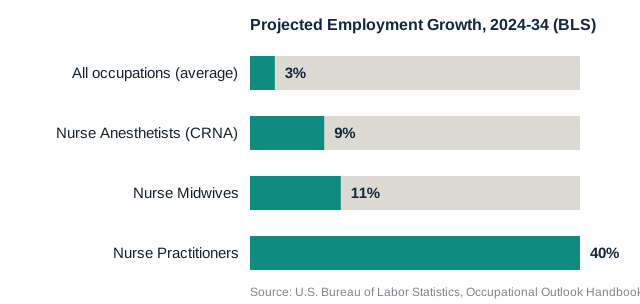
BLS projects 40% employment growth for nurse practitioners specifically from 2024 to 2034, adding roughly 128,400 jobs (from 320,400 to about 448,800). That is the fastest growth of the three related roles on this BLS page, well ahead of the 9% projected for CRNAs and 11% for nurse midwives, and far above the roughly 3% average BLS projects across all occupations for the same period. BLS attributes overall demand for advanced practice registered nurses to an aging population, rising rates of chronic disease, and a broader shift toward team-based primary and specialty care, without breaking that explanation out separately by role. Elsewhere on this site, a comparably strong BLS growth outlook shows up for speech-language pathologists, projected to grow 17% through 2035 from a 2025 base of 193,400 workers.
One thing this national wage and growth data cannot capture is how much a nurse practitioner's day-to-day scope of practice depends on the state they work in. The American Association of Nurse Practitioners (AANP), an independent membership organization rather than a BLS-affiliated source, classifies a majority of states as granting nurse practitioners "full practice authority," meaning they can evaluate, diagnose, and prescribe under the exclusive authority of the state board of nursing without a mandated physician agreement, up from 22 states in 2020. The remaining states fall under "reduced" or "restricted" practice categories that require some form of physician collaboration or supervision. Reporting a specific current count here risks going stale within a single legislative session, and different secondary sources currently report noticeably different totals for that reason, partly because some trackers count states with newly passed laws before AANP's own map has caught up. A specific state's current classification is worth confirming directly through AANP's state practice environment map rather than any single article, including this one.
BLS does not attribute nurse practitioner demand growth to the practice-authority trend directly, but the two are widely discussed together in health policy circles: as more states expand what nurse practitioners are legally permitted to do without a supervising physician, rural and underserved areas facing physician shortages have leaned more heavily on nurse practitioners to fill primary-care gaps. That is a structural, system-level explanation for the projection, not a guarantee about any individual practitioner's job security, pay trajectory, or employer, and it should be weighed alongside local job-market conditions rather than treated as a standalone forecast for one person's career.
Why specialty and setting move pay more than the national median suggests
The $129,210 BLS median is a single national figure across every nurse practitioner population focus and setting combined. Several nursing-industry and job-board sites report meaningfully higher pay for specific specialties, psychiatric-mental health nurse practitioners and acute-care nurse practitioners are commonly cited as being among the higher-paid tracks, for instance, but those figures come from self-reported salary surveys and aggregator estimates rather than from BLS's employer-reported OEWS survey, and different sites report different dollar amounts for the same specialty. This page reports that specialty is a real factor in pay without adopting any single site's specific numbers as fact, since BLS itself does not publish a specialty-level wage breakdown for this occupation. For what the role actually involves day to day beyond pay, see this site's nurse practitioner duties guide, which covers diagnosing, prescribing, and population-focus specialization per BLS.
For comparison with an adjacent advanced-practice clinical role that also diagnoses and treats patients under a graduate-level credential, see this site's guide to what a physician assistant does, a role with its own separate BLS wage data and a different, physician-collaborative supervision model in most states. Neither this page nor that one predicts what a specific person will earn; both describe national medians for occupations with real variation by state, employer, specialty, and years of experience.