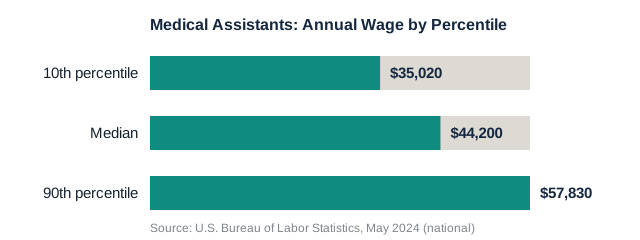
What medical assistants actually earn, by percentile
BLS tracks medical assistant pay through its Occupational Employment and Wage Statistics (OEWS) program, which surveys employers directly instead of relying on self-reported figures. The most recent published data, from May 2025, put median annual pay at $45,690, or $21.97 an hour, for a role that is nearly always paid hourly, not salaried.
Workers at the bottom 10% of this occupation earned less than $36,050 in May 2025, while the top 10% earned more than $59,310, a spread of about $23,260. That is a somewhat narrower dollar range than this site's dental assistant salary guide reports for a comparably credentialed role ($36,190 to $61,780, a roughly $25,590 spread), though the two spreads are close enough, within a few thousand dollars of each other, that neither occupation stands out as having a meaningfully wider pay ceiling than the other.
Pay by industry and practice setting
BLS breaks out May 2025 medical assistant wages across four industry categories. Outpatient care centers paid the highest median at $48,560. Hospitals (state, local, and private) paid $46,910. Offices of physicians, the setting where BLS notes this occupation's largest employment share works, paid $45,520, close to the occupation-wide median. Offices of other health practitioners, such as chiropractors or optometrists, paid the least of the four tracked categories, at $38,400.
The roughly $10,160 gap between the highest- and lowest-paying tracked industries means the specific setting a medical assistant works in moves the needle more than it does for some other allied health roles on this site. Outpatient care centers, which include facilities like urgent care clinics and ambulatory surgical centers, paid noticeably more than the smaller physician or specialist offices where a large share of the occupation is actually employed.
Job outlook: one of the fastest-growing healthcare support roles
BLS projects this occupation to grow 13% from 2025 to 2035, from 833,900 to roughly 941,500 positions, a pace the agency classifies as much faster than average. That is a net increase of 107,600 jobs over the decade. Separately, BLS projects about 109,700 average annual openings once the decade is averaged out, since most openings come from replacing assistants who transfer to other occupations or exit the labor force rather than from newly created positions alone.
BLS attributes the growth to the expanding role of outpatient care as more medical services move out of hospitals and into physicians' offices, outpatient care centers, and other ambulatory settings, along with continued demand from an aging population that requires more routine medical care. Because medical assistants handle both administrative and clinical tasks in these growing outpatient settings, BLS expects demand for the role to track that broader shift in where care is delivered.
Medical assistant vs. physician assistant: same name pattern, very different role
The similar-sounding job title is one of the most common points of confusion in healthcare hiring, and the pay gap between the two makes the distinction worth spelling out. A medical assistant typically needs a postsecondary certificate, and some enter the field with just a high school diploma plus on-the-job training, no state license is required in most states, and BLS reports a May 2025 median of $45,690. This site's physician assistant salary guide covers a role that shares a shortened name but almost nothing else: PAs must complete a master's-level program of roughly two to three years after a bachelor's degree, pass a national certifying exam, and hold a state license to diagnose patients and prescribe medication, and BLS reports their May 2024 median at $133,260, about three times the medical assistant figure.
For a closer comparison at a similar entry point, this site's dental assistant salary guide covers another allied health role that people enter through a certificate program of about a year or through on-the-job training, with a May 2024 median of $47,300, about $1,610 above the medical assistant median (the two occupations' BLS data now come from different annual cycles, since this page reflects a newer May 2025 update). Both roles typically take under a year to enter through a certificate program or employer training, and neither requires a state license to practice in most states, though some states require certification for specific expanded duties in each field. This site's LPN salary guide tracks a role at the same entry-education tier that also requires passing a licensing exam, and BLS reports a considerably higher $64,400 median for May 2025, an $18,710 gap over medical assistants despite both occupations sharing the postsecondary-nondegree entry bar. At the far end of the pay scale among radiation-oncology roles this site tracks, this site's medical dosimetrist salary guide reports a $147,470 median, more than three times the medical assistant figure above.