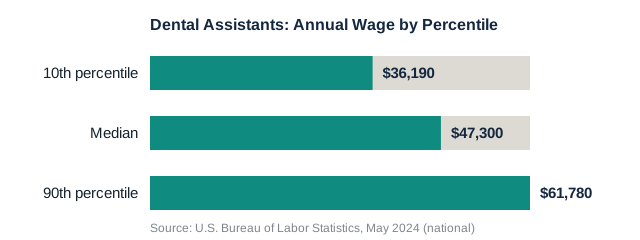
What dental assistants actually earn, by percentile
BLS tracks dental assistant pay through its Occupational Employment and Wage Statistics (OEWS) program. The program surveys employers directly instead of relying on workers to self-report their pay. The most recent published data, from May 2024, put median annual pay at $47,300, or $22.74 an hour. For context, BLS reports the median across all U.S. occupations that year at $49,500, so dental assistants earn close to, though slightly below, the broader labor-market median rather than sitting notably above or below it.
The bottom 10% of dental assistants earned less than $36,190 in May 2024, while the top 10% earned more than $61,780, a spread of roughly $25,590. That is a narrower dollar gap than several other occupations tracked on this site, including dental hygienists, whose 10th-to-90th-percentile spread runs from $66,470 to $120,060, more than double the assistant spread in dollar terms. Part of that difference traces to credentialing: dental assistants generally enter through one widely available path, either a certificate program of about a year or on-the-job training, so pay does not stretch as far based on additional formal education the way it can in fields with a licensed, degree-gated ceiling.
Pay by industry and practice setting
BLS breaks out May 2024 dental assistant wages across three industry categories, fewer than it tracks for some other occupations on this site, reflecting how concentrated the role is in a single type of employer. Government employers, excluding state and local education and hospitals, paid the highest median at $53,660. Offices of dentists, the setting where BLS notes almost all dental assistants work, paid $47,250, essentially matching the occupation-wide median. Offices of physicians paid the least of the three tracked categories, at $46,170.
The gap between the highest- and lowest-paying tracked industries, about $7,490, is notably narrower than the roughly $12,020 industry gap this site's pharmacy technician salary guide reports for that occupation. Since the large majority of dental assistants work in dentists' offices, not in government or physician settings, the industry breakdown matters less to a typical dental assistant's actual pay than it does for occupations spread more evenly across employer types.
Job outlook: growth is real, but most openings come from turnover
BLS projects employment of dental assistants to grow 6% from 2024 to 2034, from 381,900 to 406,300 positions, which the agency classifies as faster than the average for all occupations. That is a net increase of 24,400 jobs over the decade. Separately, BLS projects about 52,900 average annual openings for the occupation once the decade is averaged out, a substantially larger number than the net growth figure. Most of those openings come from replacing assistants who transfer to other occupations or leave the labor force; relatively few come from newly created positions.
BLS attributes demand for the occupation to a few converging factors: ongoing research linking oral health to general health is increasing demand for preventive dental services, and dentists continue hiring assistants to handle routine tasks so practices can run more efficiently as they grow. An aging population, combined with more people keeping their natural teeth into later life than in previous generations, is also expected to keep demand for dental care, and the assistants who support it, elevated over the projection period. For pay in the two licensed roles above the assistant, see the dental hygienist vs dentist breakdown, which uses the newer May 2025 figures.
How to become one, and how the pay compares to a dental hygienist
There are several paths into the occupation, and the requirements depend heavily on the state. Some states require dental assistants to graduate from an accredited program, most commonly offered by community colleges or vocational and technical schools, and pass an exam; most of these programs take about a year and lead to a certificate or diploma, while two-year programs leading to an associate's degree are less common. Other states have no formal education requirement at all, and assistants learn the job through on-the-job training under a supervising dentist, hygienist, or experienced assistant. Entry-level licensing generally is not required, but states that allow assistants to perform expanded duties, such as coronal polishing, do require licensure, registration, or certification for those specific tasks. Information on those certification requirements is available from CareerOneStop, the resource BLS itself points readers to.
That comparatively low and flexible barrier to entry is also what separates a dental assistant's pay from a dental hygienist's. This site's dental hygienist salary guide reports a May 2024 median of $94,260, essentially double the dental assistant median in this article. That gap tracks a real credential difference rather than a difference in the underlying work: dental hygienists must complete an accredited associate's degree program, a fixed multi-year path with a licensing exam at the end, while dental assistants can typically enter through a certificate program closer to a year in length or through employer training alone. For a comparison at a similarly accessible entry point, this site's pharmacy technician salary guide covers another allied health role with a comparable median wage, $43,460, and an even shorter formal-education requirement of just a high school diploma or equivalent. For another assistant-level allied health role, see this site's occupational therapy assistant salary guide, per BLS.