What dental hygienists actually earn, by percentile
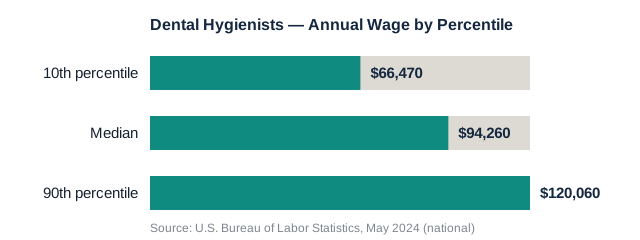
The Bureau of Labor Statistics tracks dental hygienist pay through its Occupational Employment and Wage Statistics (OEWS) program, which surveys employers directly rather than relying on self-reported figures. The most recent published data, from May 2024, put median annual pay at $94,260, or $45.32 an hour, for a role that is very often scheduled hourly, not salaried.
That median sits in the middle of a fairly wide spread. The lowest-earning 10% of dental hygienists made less than $66,470 a year, while the highest-earning 10% made more than $120,060. A nearly $54,000 gap between the bottom and top deciles reflects real differences in setting, schedule, and region, not random variation. A hygienist working four days a week in a rural practice and one working full-time in a high-cost metro area are functionally in different pay markets.
One structural note worth understanding before comparing this figure to a job posting: dental hygiene is one of the more common healthcare roles paid by the hour or by the day rather than a fixed annual salary, and many hygienists work fewer than five days a week by choice. BLS converts reported hourly wages to an annual figure by assuming full-time, full-year work (2,080 hours), so a hygienist working three or four days a week should expect actual annual earnings below the published median even if their hourly rate is at or above it.
Why the setting you work in changes the number
BLS breaks out wages by industry, and the differences are large enough to matter when comparing job offers. Offices of dentists, the setting where the large majority of hygienists work, paid a median of $94,570 a year in May 2024, essentially matching the overall median. Offices of physicians paid less, at $84,720. Government employers (excluding hospitals and state/local education) paid the least of the three, at $77,940.
That pattern is fairly typical across allied dental and medical roles. Private-practice settings that bill patients or insurers directly tend to pay more per hour than institutional or government settings, which usually offer more predictable schedules and benefits in exchange for lower direct pay. Neither setting is objectively better; the tradeoff is between hourly rate and schedule stability, and a private office does not automatically pay more once benefits are factored in.
When the gap between an online figure and an offer becomes a real hiring problem
Vyacheslav Ripa, who manages hiring for a dental practice, described a hygienist candidate who expected around $5,000 a month based on a figure she had seen online. The practice's offer landed between $3,000 and $3,500, a number that matched her actual experience level, their schedule, and the local market rather than a national or aggregator figure. Negotiating a middle ground did not close the gap enough for either side, and the offer fell through.
The BLS percentiles above describe a national spread, not what any single practice can pay for a specific schedule and experience level in a specific area. A candidate anchored to a number from a job board or salary aggregator, not a figure adjusted for their actual years of experience and the local market, can end up expecting pay a practice has no realistic way to match, even when the practice's offer is fair by BLS standards.
What the job outlook says about future pay
BLS projects employment of dental hygienists to grow 7% from 2024 to 2034, which the agency classifies as much faster than the average for all occupations, translating to roughly 15,500 additional jobs over the decade. Faster-than-average growth in a licensed, credential-gated field tends to support wage growth over time, since employers compete for a labor pool that cannot be expanded quickly: becoming a hygienist requires completing an accredited program and passing licensing exams, not just being hired and trained on the job. The same credential-gated logic plays out at a far higher pay tier this site also tracks: psychiatrist pay, which BLS pegs at a $281,870 median, reflects a medical degree and residency, not an accredited hygiene program. At the opposite end, LPN pay sits well below the hygienist figure, a $64,400 median per BLS for May 2025, built on a shorter postsecondary nondegree program; dental hygiene, by comparison, requires the associate's degree BLS lists as its typical entry path. WageLark's Salary Guide hub has BLS-sourced pay breakdowns for dozens of other occupations.
None of this is a guarantee about any individual's future earnings, and BLS data describes national averages rather than predictions for a specific person, employer, or year. It is a description of where the market has been and where employment is headed in aggregate, which is useful context for evaluating a specific job offer but should not be read as a promise about what any one hygienist will earn. For what the job actually involves day to day beyond these wage figures, see this site's guide to what dental hygienists do, covering exam findings, preventive treatments, and the supervising-dentist relationship BLS describes.