What LPNs earn, and the one-year program BLS lists as the entry path
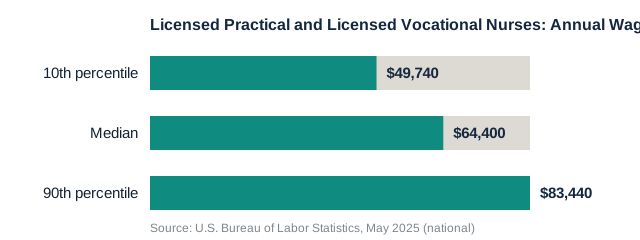
The Bureau of Labor Statistics tracks this occupation under SOC code 29-2061, covering both licensed practical nurses (LPNs) and licensed vocational nurses (LVNs), two titles for the same role that vary by which state a nurse works in. For May 2025, BLS reported a median annual wage of $64,400, or $30.96 an hour. The bottom 10% of earners made less than $49,740 a year, while the top 10% made more than $83,440, a spread of roughly $33,700.
BLS lists a postsecondary nondegree award as the typical entry-level education, earned through a state-approved certificate or diploma program that typically takes about a year, commonly offered at community colleges and technical schools, including some high schools. After finishing the program, a candidate must pass a licensing exam to enter the occupation; BLS does not name a single national exam on this page, pointing instead to CareerOneStop for state-by-state licensing board requirements.
This wage picture is built from employer payroll records, not from what LPNs and LVNs report earning themselves, since BLS's Occupational Employment and Wage Statistics survey collects its figures directly from businesses and government agencies. That same 2025 survey round counted about 666,900 LPN and LVN jobs nationally.
The highest-paying setting employs a small share of LPNs; the largest employer is a close second
BLS breaks out May 2025 wages by industry for LPNs and LVNs, and the top two categories sit close together. Government work, excluding state and local education and hospitals, paid the highest median at $68,970, but nursing and residential care facilities, the setting that employs the largest share of the workforce, paid $68,020, just $950 below the top. Home healthcare services paid $63,580, hospitals paid $61,160, and offices of physicians paid the least of the five categories BLS tracks, at $59,520.
BLS's separate Work Environment data shows 37% of LPNs and LVNs work in nursing and residential care facilities, the setting paying $68,020, second only to government work at $68,970, a category that employs just 6% of the workforce. Hospitals account for another 16% of jobs, home healthcare services 12%, and offices of physicians 11%. Unlike some occupations this site has covered, where the largest employer segment pays well below the top industry, the LPN wage table shows the setting employing the most workers landing almost exactly where the highest-paying setting does.
LPN pay next to the two adjacent nursing roles this site already tracks
LPN pay sits between two other nursing-adjacent occupations this site has separately verified against BLS. At the lower end, nursing assistants (CNAs) earn a $42,260 median for May 2025, per BLS, $22,140 below the LPN figure; BLS lists a much shorter entry bar for that role, a state-approved training program with a federal floor of just 75 clock hours under 42 CFR § 483.152, well under the roughly year-long LPN program. At the higher end sits a bigger jump: BLS reports a $93,600 median for registered nurses in May 2024 (the most recent year published on that page), $29,200 above LPN pay, tied to a bachelor's, associate's, or diploma path that commonly runs two to four years rather than about one.
BLS's How to Become One tab for LPNs and LVNs notes a direct path between the two roles it does not describe for CNAs: with experience, an LPN can complete an LPN-to-RN education program to become a registered nurse, without repeating the full entry-level RN coursework other candidates start from scratch. BLS does not quantify how much shorter that bridge path runs compared with starting an RN program with no prior nursing license, or how the pay gap between the three roles breaks down by hours of required training versus scope of clinical authority; the figures above describe what each occupation's own BLS page reports, not a claim that training time alone explains the pay differences.
Licensing, optional specialty certifications, and BLS's job outlook
Beyond the roughly year-long educational program, BLS states that all LPNs and LVNs must pass a licensing exam after completing an approved program, with state-specific requirements available through CareerOneStop. Separately from that licensing step, BLS notes that optional certifications are available through professional associations in areas such as gerontology, wound care, and intravenous (IV) therapy, credentials BLS describes as showing an LPN or LVN has an advanced level of knowledge in a specific subject; BLS does not present these certifications as a requirement to practice.
BLS projects 3% employment growth for LPNs and LVNs from 2025 to 2035, classified as about as fast as the roughly 3% average across all occupations, adding an estimated 19,700 jobs to the 2025 workforce of 666,900. About 51,800 openings are projected each year on average over the decade; BLS attributes many of those to the need to replace workers who transfer to other occupations or exit the labor force, such as to retire, rather than to newly created positions alone. BLS attributes overall demand growth to an aging population needing more residential and home-based care, along with a rise in chronic conditions such as diabetes and obesity, without assigning a specific weight to either factor.