U.S. salary & occupation data · BLS sourced Ser. 2026

Salary Guide SOC 17-1011

Do Architects Make Good Money? BLS Pay Data

The BLS architect median is $99,280, about 1.9 times the all-jobs median. See the pay range, the best-paying employers, and how long training takes.

Last updated 2026-09-26 · Wage data: May 2025 (BLS)

Bar chart showing architect annual wage by percentile: 10th percentile $62,300, median $99,280, 90th percentile $161,420, based on BLS May 2025 data.

Key figures

Do architects make good money? By BLS figures, yes: the May 2025 median was $99,280 a year ($47.73 an hour), about 1.9 times the $50,980 median for all U.S. occupations. Even the 10th-percentile architect, at $62,300, was above that national median, while the top 10% earned more than $161,420.

Architects: Annual Wage by Percentile (May 2025, U.S. national)

10th percentile
$62,300
Median
$99,280
90th percentile
$161,420

Source: BLS Occupational Outlook Handbook: Architects, May 2025.

Tool

See where your salary stands

Enter your own pay as a architects, either annual or hourly, and this tool locates it against the BLS wage percentiles above.

Pay basis

BLS publishes a median hourly wage of $47.73 for this occupation; that real figure is used as the hourly reference. Your own hourly-to-annual conversion assumes 2,080 hours/year (BLS full-time convention).

Calculated client-side from BLS Occupational Outlook Handbook: Architects, May 2025. Not personalized career, financial, or tax advice.

Industry (May 2025) Median annual wage
Government, excluding state and local education and hospitals $115,920
Architectural, engineering, and related services $98,440
Construction $95,760

Jobs (2025)

124,600

Outlook (2025-35)

4%

Employment change

+5,300

Typical entry education

Bachelor's degree

Do architects make good money compared with other workers?

By the numbers the Bureau of Labor Statistics publishes, yes. Architects had a median annual wage of $99,280 in May 2025, or $47.73 an hour. The median for all U.S. occupations was $50,980, so the typical architect out-earns the typical worker by a factor of about 1.9. Search results for this question include a Reddit post titled "Are Architects underpaid?" The BLS figures below cover the pay side of that question.

Check the label before quoting the number. BLS files this job as architects, except landscape and naval, and lists landscape architects separately. Its charts also show a wider group, architects, surveyors, and cartographers, at $87,950. The $99,280 median belongs to architects proper.

The bottom and top of the architect pay range

Do architects make good money at the low end too? A median hides the spread, so BLS also reports the ends. The lowest-paid 10% of architects earned less than $62,300 in May 2025, and the highest-paid 10% earned more than $161,420. That is a gap of $99,120 between the two ends, and the top figure is about 2.6 times the bottom one.

Even the floor beats the national median. The 10th-percentile architect wage sits $11,320 above the $50,980 median for all occupations. BLS does not break architect pay down by years of experience or license status, so the percentile range is the official picture of how pay is spread across all architects.
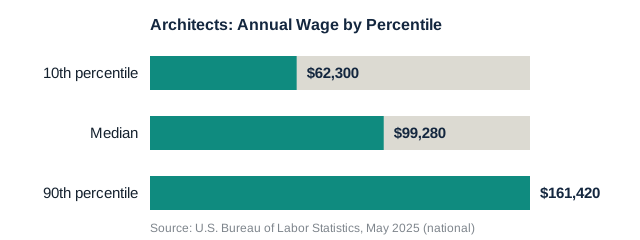
Bar chart showing architect annual wage by percentile: 10th percentile $62,300, median $99,280, 90th percentile $161,420, based on BLS May 2025 data.

Which employers pay architects the most

BLS lists median pay for three of the biggest industries. Government, excluding state and local education and hospitals, paid $115,920. Architectural, engineering, and related services paid $98,440, and construction paid $95,760. The government premium over the services firms is $17,480, or about 18%.

Employment tells you how little of the field that premium touches. About 74% of architects work in architectural, engineering, and related services, 14% are self-employed, 4% work in construction, and 3% work in government (excluding state and local education and hospitals). BLS gives no separate wage for the self-employed, so the industry list cannot say what running a small practice pays.

Do architects make good money next to jobs with different training paths?

Some jobs with shorter training pay about the same. Nuclear medicine technologists, who typically need an associate's degree, had a median of $101,370 in May 2025, which is $2,090 above the architect figure (see nuclear medicine technologist salary). MRI technologists, also typically an associate's degree, earned $95,480, or $3,800 below (see MRI tech salary).

Two master's-level jobs land almost on top of it. Genetic counselors earned a $100,040 median, only $760 more than architects (genetic counselor salary). Speech-language pathologists earned $97,870, and their 10th percentile of $62,900 is within $600 of the architect floor (speech-language pathologist salary).

For architects, BLS describes a longer path. They typically need a bachelor's degree, most often a 5-year Bachelor of Architecture, and that every state board requires a paid internship, generally about 3 years, before candidates sit the licensing exam. All states and the District of Columbia require a license. A master's degree adds 1 to 5 years, depending on prior training.

Job outlook: 4% growth and about 6,900 openings a year

About 124,600 people worked as architects in 2025. BLS projects 4% growth from 2025 to 2035, adding roughly 5,300 jobs, which it rates as about as fast as the average for all occupations (3%). It expects about 6,900 openings a year, or roughly 5.5% of current jobs, and says many come from people who transfer to other occupations or leave the labor force, such as to retire.

On automation, BLS says design work is becoming more efficient with improved building information modeling software, measuring technology, and the integration of artificial intelligence, and that the same productivity gains let architects take on more of the building process and new responsibilities. The 4% figure is a projected increase, not a decline.

Frequently asked questions

Do architects make good money?

Compared with the whole workforce, they usually do. BLS's May 2025 median for architects, $99,280, compares with $50,980 across all occupations, and the wage at the 10th percentile, $62,300, also topped the all-occupation figure. BLS has no pay figures split by seniority, so the span from the 10th to the 90th percentile ($62,300 to $161,420) is the official view of how far pay can rise.

Does it take 7 years to become an architect?

About 8 if the steps run back to back, before the exam. BLS describes a five-year B.Arch degree, the most common route, followed by a paid internship of generally 3 years before candidates are eligible to test for a license. Internship time completed during school can count toward part of that 3 years, and a master's degree can add anywhere from 1 to 5 more years.

What type of architecture gets paid the most?

BLS does not publish architect pay by specialty. It does publish industry medians for May 2025. Government pays $115,920, engineering and architecture services firms $98,440, construction firms $95,760. Those are the only pay splits on the BLS architects page, and they describe employers, not design specialties.

Is AI replacing architects?

BLS projects architect employment to grow 4% over the 2025-35 decade, about 5,300 new jobs on top of the 124,600 held in 2025. Its outlook notes that AI and modeling software make design work more efficient, and that the gains give architects room for a larger part in the full building process, plus new roles.

How much do architects make an hour?

The BLS median hourly wage was $47.73 in May 2025. BLS also notes that most architects work full time and many put in extra hours when deadlines press, so what an architect earns per hour actually worked can differ from the published hourly figure.

Cite this

WageLark Editorial, “Do Architects Make Good Money? BLS Pay Data,” WageLark, published September 26, 2026, https://wagelark.com/do-architects-make-good-money/.

This page reports government wage statistics for informational purposes. It is not personalized career, financial, or legal advice, and does not endorse or recommend any specific employer, school, or training program.

Response card

Did these figures answer your question?

Written and edited by the WageLark Editorial Team