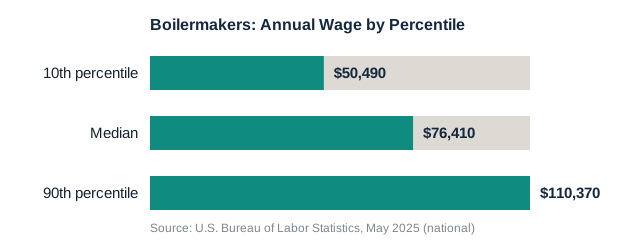
The $76,410 median, and where it lands on BLS's own comparison table
Per BLS, the median annual wage for boilermakers, who assemble, install, maintain, and repair boilers, closed vats, and other large pressure vessels, was $76,410 in May 2025, equivalent to $36.74 an hour. The bottom 10% of earners made less than $50,490, while the top 10% made more than $110,370, a spread of roughly $59,880 between the extremes. O*NET Online, a separate U.S. Department of Labor database, lists identical figures under the same SOC code, $36.74 hourly and $76,410 annually for 2025, independent confirmation of BLS's headline number.
BLS's Occupational Outlook Handbook page for boilermakers publishes a "Similar Occupations" table naming seven related trades, all pulled from the same May 2025 wage survey. Boilermaker pay lands in the upper half of that list: above welders, cutters, solderers, and brazers ($53,750), machinists and tool and die makers ($59,620), sheet metal workers ($61,800), plumbers, pipefitters, and steamfitters ($63,800), and industrial machinery mechanics ($64,100), but below stationary engineers and boiler operators, a closely related role that runs the boilers boilermakers build, at $78,620. Assemblers and fabricators sit at the bottom of the list, at $45,450.
| BLS 'Similar Occupations' (May 2025) | Median annual wage |
|---|---|
| Stationary engineers and boiler operators | $78,620 |
| Boilermakers | $76,410 |
| Industrial machinery mechanics | $64,100 |
| Plumbers, pipefitters, and steamfitters | $63,800 |
| Sheet metal workers | $61,800 |
| Machinists and tool and die makers | $59,620 |
| Welders, cutters, solderers, and brazers | $53,750 |
| Assemblers and fabricators | $45,450 |
Note that BLS's comparison table reports $53,750 for welders as of May 2025, a $2,750 increase over the $51,000 May 2024 figure this site's dedicated welder salary page currently cites, since that page has not yet cycled to the newer data year. The plumbers, pipefitters, and steamfitters figure above, $63,800, does match the current May 2025 figure on this site's plumbing page exactly.
The mildest of three declining outlooks this site tracks, and the only trade among them
BLS projects boilermaker employment will decline 2% from 2025 to 2035, a shrinking outlook rather than the flat-to-growing projections BLS publishes for most other high school diploma-entry trades this site has covered: 9% growth for electricians, 7% for plumbers, pipefitters, and steamfitters, 3% for structural iron and steel workers within the ironworker page, and 2% for welders. Two other occupations on this site also carry negative BLS projections: bookkeeping, accounting, and auditing clerks at -6% and insurance underwriters at -3%, both of which BLS attributes directly to software automating tasks those roles used to require by hand. Boilermakers post the mildest decline of the three, and are the only one that's a hands-on trade rather than office work; BLS does not cite automation as a factor on the boilermaker page.
Despite the 2% decline, BLS still projects about 700 boilermaker openings a year on average over the 2025-35 decade, all attributed to the need to replace workers who transfer to other occupations or leave the labor force, such as to retire, rather than to newly created positions. A shrinking occupation and a nonzero flow of job openings aren't a contradiction in BLS's framework: as long as any of the existing 10,200 boilermakers retire or move on each year, someone needs to fill that seat, even while the total headcount edges down. BLS's page does not explain what is driving the decline itself, beyond noting more broadly that boiler and vat installation work follows construction and industrial-plant activity.
How to become a boilermaker
Per BLS, a high school diploma or equivalent is generally the only formal education requirement to enter the trade. Most boilermakers then learn the job through a 4-year apprenticeship sponsored by unions or contractor associations, during which they train on boilermaker-specific tools and equipment, metals and installation techniques, blueprint reading and sketching, and safety practices. Completing the apprenticeship brings a worker to journey-level status.
BLS notes one entry detail that sets this trade apart from some others on this site: applicants who already have welding or other related experience have a better chance of being accepted into an apprenticeship program in the first place, even though welding experience isn't a formal prerequisite. That overlap doesn't make the two occupations the same; BLS tracks welders, cutters, solderers, and brazers as a separate SOC code from boilermakers, with its own median wage, outlook, and OOH page.
BLS's Work Environment section doesn't soften the description: "Boilermakers do physically demanding work in cramped spaces inside boilers, vats, or tanks that are often dark, damp, noisy, and poorly ventilated." The same section adds that crews work outdoors through extreme heat and cold, and because dams, boilers, storage tanks, and pressure vessels are large, the job often means laboring at great heights, occasionally hundreds of feet up on a structure like a dam. BLS's Important Qualities section lists mechanical skills, physical stamina, physical strength, and comfort working in confined spaces and at heights as the traits the job specifically calls for.
Where boilermakers work, and where the pay is highest
BLS breaks out both the industries that employ the most boilermakers and the industries that pay them the most for May 2025, and the two lists only partly overlap. Utility system construction is both the largest employer, at 21% of the workforce, and the highest-paying industry, at a $80,060 median. Nonresidential building construction employs the next-largest share, 16%, and pays the third-highest median, $74,960. Plumbing, heating, and air-conditioning contractors employ 12% of boilermakers at a $73,150 median.
The disconnect shows up at the other two industries. Other building equipment contractors pay the second-highest median of any industry BLS tracks for this occupation, $79,110, just $950 below the top spot, yet employ only 4% of the boilermaker workforce, the smallest share of the five industries BLS names. Fabricated metal product manufacturing sits at the opposite end: it employs 10% of boilermakers, more than double the top-paying niche industry's share, but pays the lowest median of the five, $63,760, about $16,300 below the utility system construction figure. BLS does not explain why the second-best-paying niche employs so few boilermakers relative to lower-paying, higher-headcount industries; the industry tables above describe what BLS itself reports side by side, not a claim about why employers in each industry set pay where they do.