What orthotists and prosthetists earn, and what the job actually involves
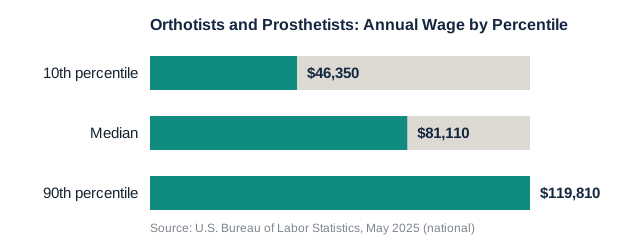
The median annual wage for orthotists and prosthetists was $81,110 in May 2025, or $38.99 an hour, per the Bureau of Labor Statistics, which profiles the combined occupation on a single dedicated page under SOC code 29-2091. The bottom 10% of earners made less than $46,350 a year, while the top 10% made more than $119,810, a spread of roughly $73,460 between the two ends. BLS counted 9,500 orthotists and prosthetists nationwide in 2025, a small workforce by this site's standards, closer in size to genetic counselors (4,200) than to larger allied-health occupations.
BLS describes the work as measuring, designing, fitting, and adapting medical devices, specifically supportive braces and artificial limbs, for patients with disabling conditions. Some workers specialize in orthotics (braces and splints that support an existing body part) or prosthetics (artificial limbs that replace one), while others do both. Most work full time in healthcare offices and in on-site laboratories, where they use tools such as drills and sanders to construct or adjust devices, and they routinely collaborate with physical therapists and occupational therapists on a patient's overall care.
A master's degree and a year-long residency, yet dental hygienists still earn more
Per BLS, orthotists and prosthetists typically need a master's degree in orthotics and prosthetics from a program accredited by a professional organization, plus a roughly one-year residency, also professionally accredited, after graduating. Master's programs generally take about two years and require a bachelor's degree to enter, and residencies can run longer for candidates who want to specialize in both orthotics and prosthetics rather than just one. BLS doesn't name the accrediting bodies on this page; it points readers to their state licensing board for licensure requirements (some but not all states require a license) and to CareerOneStop for certification information.
That is a longer, more advanced credential path than the associate degree BLS lists as the typical entry point for this site's dental hygienist salary guide. Yet BLS's own dedicated page for that occupation puts the May 2025 median for dental hygienists at $94,260, a full $13,150 above what orthotists and prosthetists earn despite the shorter, less advanced degree path. BLS does not explain the gap across its own pages; a plausible factor, not a claim BLS itself makes, is that dental hygiene has a far larger, more established private-practice market that can support routine four-day work weeks at a high hourly rate, while orthotics and prosthetics is a smaller specialty tied more closely to institutional referral patterns.
Industry pay: federal employers pay the most, hospitals pay the least, and both employ the same share of the field
BLS breaks out May 2025 median wages for orthotists and prosthetists across five industry categories. Federal government employers, excluding the postal service, paid the highest median, at $91,170, followed by medical equipment and supplies manufacturing at $83,370, health and personal care retailers at $78,320, and ambulatory healthcare services at $77,980. Hospitals (state, local, and private) paid the least of the five tracked categories, at $76,290, a gap of $14,880 between the highest- and lowest-paying settings.
BLS separately reports where orthotists and prosthetists actually work, and the pattern doesn't line up with the pay ranking. Ambulatory healthcare services employs the largest share of the field, 35%, followed by medical equipment and supplies manufacturing at 25% and health and personal care retailers at 12%. Federal government and hospitals each employ just 10% of the field, tying for the smallest share among the five tracked categories, yet those two settings sit at opposite ends of the pay scale, first and last respectively. BLS does not explain why the two smallest employer categories produced its highest- and lowest-paying settings; the data simply shows that employer share and pay rank move independently of each other here.
Job outlook: 13% growth through 2035, driven by an aging population
BLS projects 13% employment growth for orthotists and prosthetists from 2025 to 2035, classified as much faster than the roughly 3% average projected across all occupations, growing the field from 9,500 workers in 2025 to an estimated 10,700 by 2035. About 700 openings are projected each year, on average, over the decade, a figure BLS attributes mainly to the need to replace workers who transfer to other occupations or leave the labor force, such as to retire, rather than to net new job creation alone.
BLS attributes the growth itself to three demand drivers: an aging population with a rising rate of age-related conditions such as osteoarthritis and fall injuries, increasing rates of obesity and diabetes that raise demand for both orthotic foot and heel devices and prosthetic care following amputation, and the continued occurrence of trauma events, such as industrial and car accidents, that require orthotic or prosthetic care to restore mobility. None of the three factors is unique to this occupation; BLS cites similar demand drivers on several other allied-health pages this site tracks, including occupational therapy assistants, where 21% projected growth outpaces even the 13% rate here.