What BLS actually reports for surgical tech pay
Surgical technologists prepare the operating room, set up the sterile back table, pass instruments and supplies to the surgical team, and maintain the sterile field throughout a procedure. BLS tracks this role under SOC code 29-2055, and its own description on the Occupational Outlook Handbook is brief: "surgical assistants and technologists help with surgical operations." That one-line summary covers a role that is procedural and safety-driven, centered on keeping the right instrument ready and the environment sterile, rather than performing surgical steps directly.
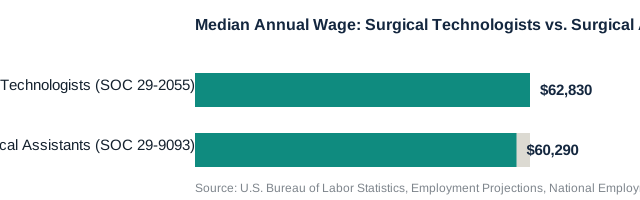
BLS publishes this occupation's Occupational Outlook Handbook page under the combined title "Surgical Assistants and Technologists," reporting a combined median annual wage of $62,480 and 141,000 combined jobs for May 2024. The narrative page does break out pay by specific role, though: the median annual wage for surgical technologists was $62,830, while the median for surgical assistants was $60,290, both May 2024. The separate BLS Employment Projections National Employment Matrix (Table 1.2), a different BLS data product from the Handbook narrative, confirms the same $62,830 figure tied specifically to SOC 29-2055 and reports a 2024 workforce of 115,600 surgical technologists, versus 25,300 surgical assistants under SOC 29-9093.
This particular Handbook page does not publish a 10th/90th percentile wage split for either role, unlike some other occupations this site covers. Readers who want that variance would need the BLS Occupational Employment and Wage Statistics (OEWS) tables directly, a separate, more granular data product. It is also worth flagging a real gap between this number and what self-reported salary sites show: search results for "surgical tech salary" surface figures like $107,000 for New York City on ZipRecruiter, roughly 70% above the BLS national median. That gap is not a data error on either side; it reflects self-reported figures skewed toward a specific high-cost metro versus BLS's employer-reported, nationally representative survey. Neither number is "wrong" for its own scope, but they answer different questions.
Surgical technologist and surgical assistant are not the same job
Despite the similar pay and BLS's combined Handbook page, the two roles have a meaningfully different scope of practice. Surgical technologists focus on instrumentation and the sterile field: setting up the operating room, passing instruments, handling specimens, and supporting the team without performing surgical steps themselves. Surgical assistants (sometimes called surgical first assistants) take on a more hands-on role directly supporting the surgeon, which can include retracting tissue, controlling bleeding, suturing, and, depending on state regulation and the assistant's credentials, performing portions of a procedure under the surgeon's direct supervision. This distinction is a general industry description confirmed by academic medical sources such as Mayo Clinic College of Medicine and Science, not a claim BLS itself makes on its Handbook page.
That wider scope makes it somewhat notable that the national median pay for surgical assistants ($60,290) is actually lower than for surgical technologists ($62,830), despite the more expansive duties. BLS does not explain this gap; it publishes the two medians without commentary. One plausible, unverified factor is that the surgical assistant workforce is much smaller (25,300 vs. 115,600) and includes a wider range of entry pathways, since some assistants enter through nursing or physician-assistant training rather than a dedicated surgical-assistant program, which could pull the reported median in either direction depending on the underlying credential mix; that is this article's inference, not a BLS-stated explanation.
BLS's own numbers show that surgical technologist is both the larger job market (about 4.5 times more workers) and the role most surgical-technology training programs are built to enter directly, while surgical assistant credentials are typically layered on after establishing a technologist or nursing background.
Certification and how people enter the field
BLS lists the typical entry-level education for this occupation as a postsecondary nondegree award, meaning a certificate program rather than a full associate degree, with no additional work experience or on-the-job training required beyond that program. In practice, surgical technology programs are accredited either by the Commission on Accreditation of Allied Health Education Programs (CAAHEP) or the Accrediting Bureau of Health Education Schools (ABHES), and graduating from one of those accredited programs (or completing equivalent military surgical-technology training) is the standard eligibility path into the field's primary credential.
That credential is the Certified Surgical Technologist (CST), administered by the National Board of Surgical Technology and Surgical Assisting (NBSTSA) and described by NBSTSA as the most nationally recognized surgical technology credential in the U.S. Maintaining it requires earning 30 continuing education credits (including 4 defined as live) within a two-year renewal cycle, or retaking the exam. NBSTSA's current renewal system runs on that single two-year cycle; an older four-year, 60-credit option some other sites still mention has since been consolidated into it. BLS states that employers may require or prefer certification and that some states regulate these workers directly. Requirements vary by state, and this page does not claim a single national licensing standard.
Within the broader "postsecondary nondegree award" entry tier this site covers, surgical technologist pay sits well above phlebotomists, whose median annual wage is $43,660. Both roles share the same typical entry credential level, but the operating-room setting and CST certification requirement appear to carry a real pay premium within that tier, even though BLS itself does not attribute the gap to any single cause.
Job outlook and where this fits among allied health pay
The BLS Employment Projections National Employment Matrix projects 4.5% employment growth for surgical technologists specifically from 2024 to 2034, adding about 5,200 jobs on top of a 2024 base of 115,600, with roughly 7,000 average annual openings once retirements and occupational transfers are included. That is faster than the roughly 3% growth projected across all occupations combined, though BLS does not publish a stated explanation for the growth on this occupation's Handbook page the way it sometimes does for other roles; rising surgical volume tied to an aging population is a plausible, unverified factor rather than a claim BLS makes directly.
Compared with radiologic technologists, another associate-degree-or-certificate-level allied health role that supports physicians rather than practicing independently, surgical technologists earn a lower national median ($62,830 vs. $77,660) but face a similar growth rate (4.5% vs. 4%). The gap in pay likely tracks entry credential depth more than growth outlook: radiologic technology typically requires a full associate's degree, while surgical technology's typical entry point, a postsecondary certificate, is usually a shorter and less expensive path to a first paycheck. At the long-training end, architects need a bachelor's degree plus a paid internship and a licensing exam, and BLS put their May 2025 median at $99,280 (see the architect pay guide).
None of these figures predict what a specific person will earn. They describe national medians and projections for occupations with real variation by state, employer setting, and individual certification, and readers comparing a specific job offer against these numbers should weigh local market conditions alongside the national baseline rather than treating either as a guarantee.