The degree BLS says you need, and what it covers
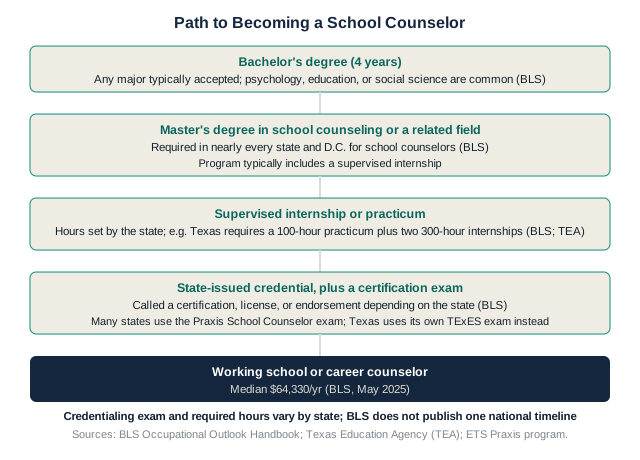
Per BLS, nearly all states and the District of Columbia require school counselors to hold a master's degree, typically in school counseling or a related field such as counseling or psychology. A bachelor's degree in any major is generally the entry requirement for these graduate programs; BLS notes the coursework covers skills such as fostering student development, running group and individual counseling sessions, working with parents and school staff, and using data to build and evaluate a school's counseling program. These master's programs typically require an internship as part of earning the degree. By contrast, this site's guide to how long RN programs take covers a field with three separate BLS-recognized entry paths, a bachelor's, an associate's, or a hospital diploma program, each running about the same length.
Career counselors and advisors, the other half of this BLS occupational category, face a lighter typical bar: BLS says some employers prefer a master's degree focused on career development, but for career or academic advisor roles specifically, employers may instead accept a bachelor's degree plus relevant work experience. BLS does not name a single credentialing body for career counselors comparable to what applies to school counselors, and notes that only some states require licensure for this half of the occupation.
The credentialing exam: Praxis in many states, but not in Texas
Per BLS, public school counselors must hold a state-issued credential to practice, which depending on the state may be called a certification, a license, or an endorsement; earning it typically requires the master's degree above, a supervised internship or practicum, and passing a test. BLS does not name a specific exam, directing candidates instead to their state's own licensing board or to CareerOneStop, a U.S. Department of Labor resource, for state-specific requirements.
In practice, many states use a Praxis exam from ETS, the School Counselor test (numbered 5422, which as of September 2022 replaced an earlier version numbered 5421); passing scores for it differ by state, with most states that use it setting the bar at 159, while Arkansas accepts as low as 146, Missouri sets 149, and Mississippi and Utah both require 153. Texas is a documented exception that skips the Praxis series entirely: its State Board for Educator Certification instead requires its own exam, the Texas Examinations of Educator Standards (TExES) School Counselor EC-12 test. Texas separately requires a 48-hour school-counseling master's degree from an accredited educator preparation program (Texas Administrative Code 239.20), a 100-hour supervised practicum, and two further 300-hour supervised internship placements; as of September 2023, following Senate Bill 798, Texas also no longer requires school counselor candidates to have prior classroom teaching experience, reversing a requirement some other states still carry. Because the credentialing exam and the supervised-hour minimums both vary this much between just two examples, confirming requirements with the specific state licensing board remains the reliable step, exactly as BLS and CareerOneStop both point candidates to do.
What school and career counselors actually do, and where the jobs are
BLS splits this occupation's day-to-day duties by setting. School counselors typically help students work through social or behavioral challenges, analyze attendance and academic data to spot problems early, evaluate student abilities through assessments and interviews, and coordinate with teachers and families on academic, career, and social planning; duties shift by grade level; BLS describes elementary counselors focusing on social and academic skill-building, middle school counselors easing the transition to high school, and high school counselors advising on college applications, financial aid, and job-search skills. Career counselors and advisors, the occupation's other half, typically use aptitude assessments to help clients evaluate skills and interests, guide decisions about which degree or credential to pursue, and teach job-search skills such as résumé writing and interviewing; BLS notes a subset called career coaches works specifically with people already in the workforce, while college advisors specialize in helping students choose majors and navigate one part of the college experience, such as financial aid or admissions.
School and career counselors and advisors held about 389,500 jobs in 2025, per BLS, with local elementary and secondary schools the single largest employer at 38% of the total; the rest of the field is spread across public and private colleges and universities, private K-12 schools, and other private educational services, none of which BLS reports as approaching that 38% share on its own.
Pay, by setting, against other master's-level school careers on this site
BLS reports a median annual wage of $64,330 for school and career counselors and advisors in May 2025, or $30.93 an hour, above the $50,980 median for all occupations that year but below the $58,300 median it separately reports for the broader group of counselors, social workers, and other community and social service specialists this occupation belongs to. The bottom 10% of school and career counselors and advisors earned less than $45,020, and the top 10% earned more than $104,770.
By industry, BLS reports the highest median pay in local elementary and secondary schools, at $77,800, the same setting that employs 38% of the field; private elementary and secondary schools follow at $62,190, then public colleges and universities at $58,870, private colleges and universities at $58,720, and other private educational services at $57,480, the lowest of the five tracked settings. BLS projects 3% employment growth from 2025 to 2035, about as fast as the average for all occupations, adding an estimated 11,400 jobs to the 389,500 already employed, with about 27,800 openings projected each year on average, mostly from workers transferring to other occupations or leaving the labor force.
Against other education- and human-services careers this site tracks, the school counselor median sits within about $10 of librarians (whose most recently reported BLS median was $64,320, though for the May 2024 data year rather than May 2025), above social workers at $61,330, an occupation whose overall median blends a bachelor's-level entry path with a master's-level clinical track, and well below psychologists at $94,310, an occupation whose largest specialty by headcount typically requires a doctoral rather than a master's degree. BLS does not attribute these gaps to a specific cause; the comparison describes what each occupation's own BLS profile reports, not a claim that one credentialing path pays better than another for a given reader.