How most paralegals get in the door
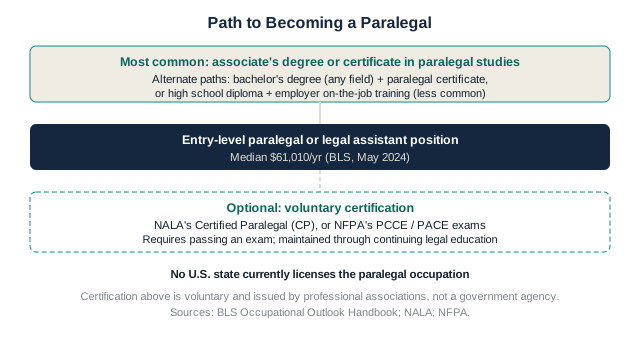
Per BLS, paralegals and legal assistants typically need an associate's degree or a certificate in paralegal studies to enter the occupation. The most common route is a dedicated associate's degree program at a community college or similar institution, which BLS says usually includes courses in legal research, legal writing, and an introduction to law and the legal system, along with coursework in a specific practice area such as criminal, family, or contract law.
BLS describes two other entry paths on the same page. Some employers prefer or require a bachelor's degree, and candidates who already hold one in an unrelated field, commonly social science or business, can add a shorter paralegal studies certificate rather than pursue a second full degree. A third, less common path skips formal paralegal education altogether: BLS notes some employers hire candidates with no legal experience or education, often just a high school diploma, and train them on the job, particularly for specialized practice areas. This site's social worker guide covers a related human-services field with its own split entry bar, a bachelor's degree for nonclinical roles or a master's for clinical practice, per BLS.
BLS says paralegal studies programs are typically accredited by professional organizations; there's no one single national accrediting body. One recognized standard is approval by the American Bar Association: NFPA's advanced certification exam, covered below, explicitly accepts degrees from an institutionally accredited and/or ABA-approved paralegal program as one path to eligibility. ABA approval is voluntary for a school and is not required to enter the occupation.
Certification is voluntary, not a state license
Unlike some other occupations covered on this site, where a state license is required to work independently, no U.S. state currently licenses the paralegal profession, according to NFPA, the National Federation of Paralegal Associations. NFPA notes several states are working on regulatory frameworks, but as things stand, using the title "paralegal" does not require a government-issued license anywhere in the country. That is a sharp contrast with this site's timeline for becoming a dentist, which per BLS runs 8 years and ends in mandatory state licensing exams.
That does not mean credentials are absent from the field, only that they are voluntary and come from professional associations, not a government body. The National Association of Legal Assistants (NALA) offers the Certified Paralegal (CP) credential through one of three eligibility routes: completing an ABA-approved or otherwise institutionally accredited paralegal studies program (associate's, bachelor's, or post-baccalaureate certificate, or a program of at least 60 semester hours including 15 hours of substantive legal coursework), holding a bachelor's degree in any field plus at least one year of paralegal experience, or holding a high school diploma plus at least five years of paralegal experience and 20 hours of continuing legal education completed in the two years before applying. Candidates who qualify must pass a three-hour, multiple-choice Knowledge Exam before they are eligible to sit for a separate two-hour, written Skills Exam; passing both is required to earn the CP designation.
NFPA runs a separate pair of exams. The Paralegal CORE Competency Exam (PCCE) is an entry-level credential that leads to the CRP designation, aimed at candidates whose education, rather than years of on-the-job experience, demonstrates readiness. The Paralegal Advanced Competency Exam (PACE) is aimed at paralegals with a comprehensive education plus substantial practical experience, generally two to six years depending on degree level, and leads to the RP designation. BLS confirms the general pattern without naming a specific organization: certification typically requires passing an exam, and maintaining it typically requires a set number of continuing-education hours, which for both NALA's and NFPA's credentials takes the form of continuing legal education (CLE).
What the job pays, once you get there
BLS reports a median annual wage of $61,010 for paralegals and legal assistants in May 2024, or $29.33 an hour. The bottom 10% earned less than $39,710, and the top 10% earned more than $98,990, a spread of roughly $59,000. Pay also varies substantially by industry, with federal government roles paying the highest median tracked and state government the lowest; for the full industry-by-industry breakdown and a closer look at what the day-to-day work involves, see what does a paralegal do.
Against the shortest entry path this site has covered, becoming a CNA requires a federal minimum of just 75 hours of training rather than a multi-year degree, and BLS puts the median nursing assistant wage at $42,260, about $18,750 below the paralegal figure above. Whether the extra years of schooling are worth that gap depends on a reader's own finances and goals, a call this site's national wage figures are not built to make.
What flat growth doesn't tell you: 39,300 openings a year, and why
BLS projects essentially flat employment for paralegals and legal assistants from 2024 to 2034, describing the outlook as "little or no change," but flat growth doesn't mean a closed job market: BLS still counts roughly 39,300 openings a year on average, most of them from replacing workers who leave the field, not from newly created positions. See this site's what a paralegal does page for the full growth breakdown and how it stacks up against other occupations covered here. A faster-growing, shorter-training occupation by comparison, this site's flight attendant training guide covers FAA-mandated certification with 9% growth projected through 2035, per BLS.
BLS attributes part of the limited growth specifically to technology, stating that advances including artificial intelligence are expected to make paralegals and legal assistants more efficient at tasks such as conducting research and preparing documents, which may reduce demand for these workers going forward. That is a more specific, technology-driven explanation than BLS gives for most occupations on this site.
On its "Similar Occupations" table, BLS lists lawyers at a 2024 median of $151,160, which requires a doctoral or professional degree, and secretaries and administrative assistants at $47,460, which requires only a high school diploma. The paralegal role sits between those two entry-education tiers on both pay and required schooling, a middle position that lines up with the mix of entry paths described above.