What the role actually covers
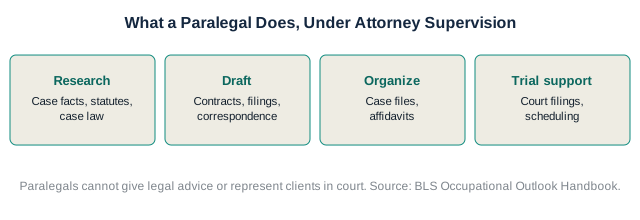
The Bureau of Labor Statistics describes paralegals and legal assistants as professionals who support lawyers through "maintaining and organizing files, conducting legal research, and drafting documents." That covers a fairly wide range of concrete tasks: investigating the facts of a case, researching relevant statutes and case law, drafting correspondence, contracts, and legal filings for an attorney's review, obtaining sworn statements (affidavits), assisting during trial preparation and proceedings, filing documents with courts, and scheduling client interviews and depositions.
A key distinction from the attorney role: paralegals cannot give legal advice, represent clients in court, or set legal fees. The work is substantive but always performed under an attorney's supervision and final authority. What varies most is scope: at a small firm, a paralegal might handle nearly every non-courtroom aspect of a case from intake to filing; at a large firm, paralegals are more often assigned to a specific phase of a case (discovery, document review, trial prep) within a particular practice area like litigation, intellectual property, or bankruptcy.
Where the pay actually is
BLS industry data for May 2024 shows a wider-than-expected gap by employer type. Federal government roles paid the highest median at $77,940, followed by finance and insurance at $76,960, both well above the $61,010 national median. Local government paid $60,990, close to the median. Legal services (meaning law firms themselves, the setting most people picture) paid $59,800, and state government paid the least of the tracked categories at $56,280.
The pattern suggests that paralegals working inside a company's in-house legal or compliance function (finance and insurance) or for a federal agency often out-earn paralegals working at a traditional law firm. BLS does not break down why the gap exists by industry, so the figures above are the most specific picture available.
Education path and job outlook
Most paralegal positions require an associate degree in paralegal studies, or a bachelor's degree in another field combined with a paralegal certificate program. Separately, BLS notes that employers will also train candidates on the job with little formal paralegal preparation, whether that means a bachelor's-degree hire without legal-specific coursework or a candidate with only a high school diploma, particularly for specialized practice areas; a paralegal certificate is increasingly treated as close to a baseline expectation regardless of which path a candidate starts from.
BLS projects essentially flat employment for paralegals from 2024 to 2034: 0% growth, described as "little or no change," adding only about 600 net jobs over the decade. Flat growth is not the same as few job openings, though: BLS separately projects about 39,300 paralegal openings a year on average over the decade, with most coming from the need to replace workers who transfer to other occupations or leave the labor force, such as to retire, rather than from newly created positions. Even accounting for that, this is a noticeably weaker net-growth outlook than most other occupations covered on this site, worth weighing against the relatively low barrier to entry: demand growth in this field is not expected to be a strong tailwind over the next decade the way it is in several healthcare roles. The rest of WageLark's Career Guide hub covers what a controller and a bookkeeper actually do, among other roles.