What veterinarians earn, and the doctoral degree BLS says it takes to get there
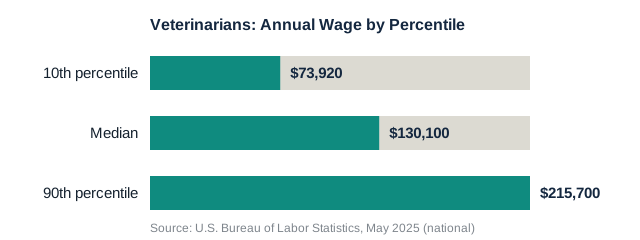
The Bureau of Labor Statistics tracks this occupation under SOC code 29-1131, on a page dedicated to veterinarians alone. For May 2025, BLS reported a median annual wage of $130,100, or $62.55 an hour. The bottom 10% of earners made less than $73,920 a year, while the top 10% made more than $215,700, a spread of roughly $141,780, one of the widest percentile ranges this site has found among the occupations it tracks. BLS does not attribute that spread to any single factor on this page, though the industry breakdown below accounts for some of it.
BLS lists a doctoral or professional degree as the typical entry-level education for this occupation, specifically a Doctor of Veterinary Medicine (DVM) or, at a small number of schools, a Doctor of Veterinary Medicine degree titled VMD. That places veterinarians in the same broad credential tier as pharmacists, whose typical entry path is also a four-year professional doctoral degree (a PharmD) after an undergraduate foundation; BLS reports a $137,480 median for pharmacists, about $7,380 above the veterinarian figure, a narrower gap than the very different animal-versus-human-medicine scope of the two fields might suggest. A similar doctoral-entry structure shows up outside veterinary medicine too: this site's audiologist pay data covers a $95,780 median for a role that, per its own BLS page, also typically requires a four-year clinical doctorate.
These figures come from BLS's Occupational Employment and Wage Statistics survey, which draws wage data from employer payroll and self-employment records rather than worker self-reports. The same survey counted about 91,100 veterinarian jobs in 2025.
Why the highest-paying setting is close to where most veterinarians actually work
BLS breaks out May 2025 wages by industry for veterinarians, and the four categories it tracks sit closer together than the percentile spread above might suggest. Social advocacy organizations paid the highest median, at $131,760, but veterinary services, the industry that covers ordinary clinical practice, paid $129,990, just $1,770 below the top category. Educational services (state, local, and private) paid $121,890, and government work, excluding state and local education and hospitals, paid the least of the four, at $115,210.
BLS's separate Work Environment data shows that 83% of veterinarians work in veterinary services, the industry paying $129,990, second only to social advocacy organizations and just $1,770 below it. Self-employed workers account for another 7%, with government (2%), educational services (2%), and social advocacy organizations (1%) making up the rest. That is a closer match between where the jobs are and where the pay is than this site found for veterinary technicians, a closely related occupation where BLS reports 89% of the workforce works in veterinary services, which pays $45,740 there, about $5,510 (roughly 12%) below that field's highest-paying category, educational services, at $51,250. In both occupations, the industry employing most of the workforce turns out to be the second-highest-paying one BLS tracks, not the lowest, though the gap to the top is far smaller for veterinarians than for veterinary technicians.
Becoming a veterinarian, and how the entry path compares to becoming a veterinary technician
Per BLS, prospective veterinarians need a Doctor of Veterinary Medicine (DVM or VMD) degree from an accredited college of veterinary medicine, a program that typically takes four years and combines classroom instruction, laboratory work, and clinical training, with the final year spent on clinical rotations. All states require completing an accredited program and passing a qualifying exam; most states also require a separate state-level exam covering state veterinary laws and regulations, and BLS notes that few states accept a license issued by another state without additional steps.
Independently of BLS, the accrediting body behind that "accredited college" requirement is the American Veterinary Medical Association's Council on Education, and the field's national licensing exam, the North American Veterinary Licensing Examination (NAVLE), is administered by the International Council for Veterinary Assessment (ICVA, formerly named the National Board of Veterinary Medical Examiners), a computer-based test now offered during three testing windows a year that fulfills a core licensure requirement in every U.S. state and Canadian province. Candidates generally must be enrolled in, or have graduated from, an AVMA-accredited program to sit for it.
That doctoral-degree, board-exam path stands in sharp contrast to entry into veterinary technician and technologist work in the same field, which BLS lists as typically requiring only an associate's degree, roughly two years of postsecondary study versus four years of professional school after a bachelor's degree for veterinarians. The pay gap between the two roles, $130,100 for veterinarians versus $45,980 for veterinary technicians and technologists, a difference of $84,120, tracks that credential gap more closely than the setting comparison above tracks the industry-wage gap within either occupation alone.
Job outlook, and a physical risk BLS states directly
BLS projects 9% employment growth for veterinarians from 2025 to 2035, classified as much faster than the roughly 3% average across all occupations, taking the occupation from 91,100 to a projected 99,600 jobs (a BLS-published figure that does not sum exactly from the 91,100 and 8,600 above, since BLS rounds each figure independently) and adding about 8,600 positions. BLS attributes that growth to rising consumer spending on pet care, expanding treatment options, and a pet population that is both growing and aging, without assigning a specific weight to any one of those three factors. About 3,100 openings are projected each year on average over the decade, and BLS attributes many of those annual openings to workers transferring to other occupations or leaving the labor force entirely, such as to retire, rather than to newly created positions alone.
Separately from the pay and growth figures, BLS states that most veterinarians work full time, often exceeding 40 hours a week, and describes a direct physical risk of the job: veterinarians can be "bitten, kicked, and scratched" while handling frightened or injured animals during exams and procedures. BLS does not attach a specific injury-rate figure to that statement on this page, unlike the comparative "one of the highest rates of injuries and illnesses" language this site has found on the veterinary technician BLS page; it is a description of the hazard itself rather than a quantified claim this site can independently verify against a separate BLS injury dataset.