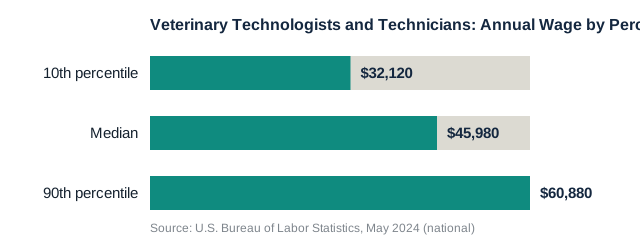
What veterinary technicians earn, and the two credential levels BLS bundles together
BLS tracks this role under SOC code 29-2056, "Veterinary Technologists and Technicians," a title that covers two distinct credential tracks with one combined median wage. Technicians typically complete a 2-year associate's degree in veterinary technology; technologists complete a 4-year bachelor's degree in the same field. Both must pass a credentialing exam and become registered, licensed, or certified, with the specific requirement set by the state where they work. BLS reports Associate's degree as the "typical" entry-level education for the combined occupation, which understates what technologists specifically complete, since the Handbook does not publish a separate median wage for the bachelor's-level technologist track alone.
The median annual wage for veterinary technologists and technicians was $45,980 in May 2024 ($22.11 an hour). The bottom 10% earned less than $32,120 a year, while the top 10% earned more than $60,880, a spread of roughly $28,760. That range is narrower than the spreads this site has found for several other allied health roles with an associate's degree as the entry point, which suggests less pay differentiation by specialty certification or region within this specific occupation.
One comparison worth naming directly: radiologic technologists and technicians also typically enter with an associate's degree and also sit for a licensing exam, yet BLS reports a $77,660 median for that role, about $31,680 more than veterinary technicians earn despite a comparable entry credential. BLS does not explain the gap on either page. It most plausibly traces to which industries buy the two services, hospital and outpatient healthcare systems versus small private veterinary practices, rather than to the training itself, though that reasoning is this article's own, not something BLS states.
Within veterinary medicine itself, the credential gap runs much wider than the associate's-versus-bachelor's split covered above: veterinarians need a four-year doctoral degree (a DVM) after a bachelor's plus a national licensing exam, and BLS puts their median at $130,100, a difference of $84,120 from the veterinary technician figure on this page.
Why the credential barely shows up in the paycheck
Veterinary technicians and technicians must complete a postsecondary program, pass a credentialing exam, and hold a state registration, license, or certification depending on where they work, per BLS. Despite that formal gate, the $45,980 median sits close to two allied roles that require no degree at all: medical assistants, whose typical entry-level education is a postsecondary nondegree award, have a median of $44,200, just $1,780 below veterinary technicians; dental assistants, also entering with a nondegree award, have a median of $47,300, about $1,320 above. On this specific comparison, the extra one-to-two years of formal veterinary technology coursework and a licensing exam do not correspond to noticeably higher typical pay than assistant-level roles that require neither.
BLS does not publish a causal explanation for why credential level and pay diverge here. One plausible, unverified factor is that veterinary care is overwhelmingly funded by pet owners paying out of pocket rather than by insurance reimbursement or larger institutional budgets the way medical and dental assistant positions more often are, which caps what small private practices can pay regardless of staff credentials. That is this article's own inference, not something BLS states.
BLS separately breaks out May 2024 median wages by industry for this occupation, and the industry difference is larger than the credential-comparison gap above: educational services (state, local, and private) paid a median of $51,250, the highest of the four categories BLS tracks, followed by veterinary services itself at $45,740, other personal services at $43,280, and social advocacy organizations at $41,640, a spread of about $9,610 between the top and bottom industry.
Where the jobs are concentrated
BLS reports that veterinary services employed 89% of the 134,200 veterinary technologists and technicians working in 2024. That industry pays $45,740, the second-highest of the four categories BLS tracks, about $5,510 (roughly 12%) below the highest-paying category, educational services, at $51,250, which employed only about 4% of the workforce. Social advocacy organizations and other personal services, the two lowest-paying categories, each employed roughly 1%. In practical terms, the setting employing the vast majority of the workforce pays close to, not far below, the top of what BLS tracks for this occupation. That gap is wider than the same comparison for veterinarians, where 83% of the workforce works in an industry just $1,770 below the top category, versus the $5,510 gap here.
BLS also states that veterinary technologists and technicians "have one of the highest rates of injuries and illnesses of all occupations," a direct quote from the Handbook's Work Environment section, tied to handling scared or aggressive animals during exams, restraint, and euthanasia procedures. BLS does not attach a specific injury-rate number to that statement on this page; it is a comparative claim about the occupation's standing relative to others, not a quantified figure this site can independently verify against a separate BLS injury dataset for this specific title.
Job outlook, and how it compares across the pet-care field
BLS projects 9% employment growth for veterinary technologists and technicians from 2024 to 2034, classified as much faster than the roughly 3% average projected across all occupations, taking the occupation from 134,200 to 146,400 jobs and adding an estimated 12,200 positions. BLS also projects about 14,300 openings a year on average over the decade, a figure driven mostly by the need to replace workers who leave the occupation entirely or exit the labor force, rather than by net new job creation alone.
BLS attributes the growth mainly to rising numbers of pet-owning households and continued increases in spending on pet care, along with expanding treatment options that require more diagnostic and nursing support per animal. That is a demand-side projection about the pet-care industry as a whole, not a forecast about pay: nothing in the BLS growth projection implies the credential-versus-pay gap described above will close, since faster hiring and higher wages do not necessarily move together within the same occupation.
Readers comparing veterinary care pay against other associate's-degree or nondegree allied health roles can also see this site's guides to radiology tech salary and medical assistant salary for two directly comparable BLS-tracked occupations.